Hekate by Nikita Gill
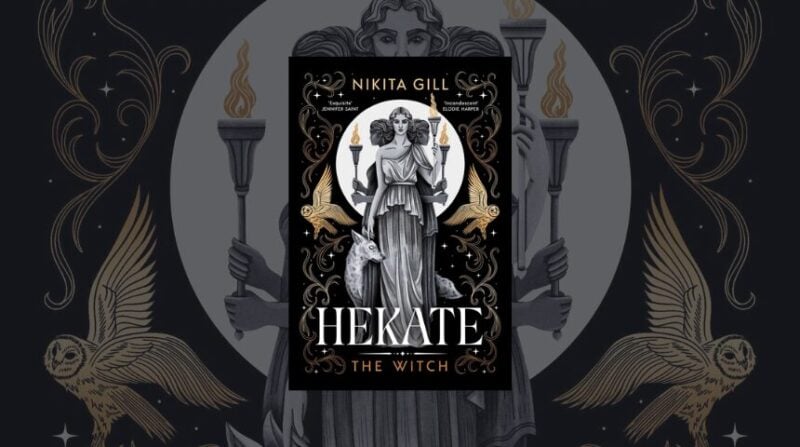
In recent years, Greek mythology has experienced a remarkable revival in modern fiction, with authors finding fresh ways to reinterpret stories that have captivated readers for more than two thousand years. Nikita Gill’s Hekate: The Witch is an outstanding addition to this growing body of literature, nominated for a Goodreads Choice Award in 2025. Rather than revisiting the familiar tales of heroes such as Odysseus or Achilles, or even the increasingly popular stories of figures like Circe and Ariadne, Gill turns her attention to one of the most enigmatic deities of the ancient Greek world. The result is a novel that feels both fresh and timeless, introducing many readers to a goddess who has long existed on the fringes of mythology while demonstrating why she deserves to stand alongside the better-known Olympians.
Gill is already well known for her poetry and her modern interpretations of classical myths, and those strengths are evident throughout Hekate: The Witch. Her prose is elegant and lyrical without becoming difficult to read, allowing the novel to appeal both to readers who are deeply familiar with Greek mythology and to those encountering these stories for the first time. Rather than presenting mythology as a collection of disconnected legends, Gill treats it as a living tradition capable of speaking to contemporary audiences about identity, resilience, belonging, and the search for purpose.
Perhaps the novel’s greatest achievement is its willingness to focus on a figure whose story has rarely been explored in depth. Ancient Greek literature tells us a great deal about Hekate’s powers and influence but surprisingly little about her personal history. That absence provides Gill with the freedom to imagine the goddess’s world while remaining respectful of the surviving myths. The result is a novel that feels authentic to the spirit of Greek mythology without being constrained by the need to retell stories that readers already know by heart. You might enjoy our old blog post about Hekate in Shakespeare’s Macbeth before you read more here.
The Story in Hekate: The Witch
At its heart, Hekate: The Witch is a character-driven exploration of one of Greek mythology’s most fascinating goddesses. Rather than relying on large-scale battles or dramatic twists, the novel focuses on themes of self-discovery, belonging, and the responsibilities that come with extraordinary gifts. Gill presents Hekate not simply as the mysterious goddess remembered by later generations, but as a figure whose identity is shaped by the world around her and by the choices she makes.
Although the novel is rooted firmly in Greek mythology, it never feels like a history lesson. Gill blends mythological tradition with emotional storytelling, creating a narrative that is accessible even for readers with little prior knowledge of the ancient world. The pace is thoughtful rather than fast, allowing readers to appreciate the atmosphere, relationships, and symbolism that define the novel.
Instead of emphasizing action, the story invites readers to immerse themselves in the rich mythology surrounding Hekate. The novel succeeds because it values emotional growth and philosophical questions as much as dramatic events, making it a rewarding experience for readers who appreciate reflective fantasy grounded in classical tradition.
The Greek Mythology Behind Hekate
One of the most fascinating aspects of the novel is the mythology that inspires it. Hekate occupies a unique place within the Greek pantheon. Although she belongs to the older generation of divine beings associated with the Titans, she is unlike almost every other Titan in the surviving myths. Ancient sources portray her as a goddess who continued to enjoy immense respect even after the Olympian gods came to power, a distinction that immediately sets her apart from many of her contemporaries.
The earliest and most important description of Hekate appears in Hesiod’s Theogony, written around the eighth century BCE. There she is described as a goddess honoured by Zeus himself and granted authority over the heavens, the earth, and the sea. She is associated with kingship, justice, victory, prosperity, fertility, and protection, making her far more influential than many readers might expect.
Over time, however, Hekate became increasingly associated with magic, witchcraft, ghosts, crossroads, the night, and the mysteries of the Underworld. Later Greek and Roman writers portrayed her carrying torches, accompanied by black dogs, and serving as a guardian of places where different worlds seemed to meet. These powerful symbols have ensured her lasting popularity, particularly among modern readers interested in mythology, folklore, and ancient religion.
Gill draws upon all of these traditions. Rather than choosing only one version of Hekate, she embraces the goddess’s many different identities and presents them as complementary aspects of an extraordinarily complex divine figure.
The Underworld Reimagined
The Underworld has always been one of the most intriguing settings in Greek mythology, and Gill captures its atmosphere with remarkable imagination. Modern popular culture often simplifies the Greek Underworld by comparing it to the Christian concept of Hell, but the mythology itself presents something much more nuanced. For the ancient Greeks, the Underworld was simply the destination of the dead, a realm that reflected the complexity of existence rather than serving as a place of eternal punishment.
Gill embraces this richer interpretation, portraying the Underworld as a place filled with mystery, memory, and ancient power. It is a landscape shaped by myth, populated by divine beings, legendary creatures, and spirits whose presence contributes to an atmosphere that is simultaneously haunting and beautiful.
The novel also reflects a more historically accurate understanding of Hades himself. Contrary to many modern portrayals, Hades was not considered an evil god by the ancient Greeks. He ruled over the dead with fairness and order, rarely displaying the impulsive behaviour often associated with other Olympian gods. Gill’s interpretation reflects this tradition, helping readers appreciate how Greek mythology viewed death not as an enemy but as an inevitable part of the natural order.
The Titanomachy as Emotional History
One of the most interesting elements of Hekate: The Witch is the way it uses one of Greek mythology’s defining events as a backdrop without allowing it to overshadow the novel’s more personal themes. The Titanomachy, the legendary struggle between the Titans and the Olympian gods, is one of the foundational myths of ancient Greece, explaining how Zeus and his siblings came to rule the universe.
Rather than focusing on the spectacle of this cosmic conflict, Gill uses its historical significance to enrich the emotional landscape of the novel. The ancient myths often present the Titanomachy as a straightforward victory for the Olympians, but modern authors have increasingly explored the perspectives of those whose stories remained untold. Gill follows this tradition by reminding readers that every mythological age begins with profound change, and that even the greatest victories reshape the lives of countless individuals.
This approach gives the novel a timeless quality. Although inspired by ancient mythology, its exploration of displacement, change, and adaptation resonates strongly with modern readers, demonstrating once again why Greek myths continue to feel relevant in the twenty-first century.
Magic, Witchcraft, and Crossroads
Hekate’s enduring popularity owes much to her association with magic, and Gill explores this aspect of the goddess with both sensitivity and historical awareness. Rather than treating magic as merely a source of spectacular supernatural abilities, the novel presents it as something deeply connected to wisdom, intuition, ritual, and transformation.
In Greek religion, Hekate presided over crossroads, liminal spaces, and moments of transition. Crossroads were sacred places because they represented choice, uncertainty, and the meeting of different paths. Likewise, Hekate herself came to symbolize the boundaries between life and death, light and darkness, certainty and mystery.
Gill uses these ancient symbols throughout the novel, giving them emotional as well as mythological significance. Torches become symbols of guidance, darkness represents both uncertainty and hidden knowledge, and magic itself is portrayed as a force connected to understanding rather than domination. This interpretation aligns remarkably well with the ancient traditions surrounding Hekate while making those traditions meaningful for modern audiences.
Poetry as Storytelling
Nikita Gill first established her reputation as a poet, and that background is evident throughout Hekate: The Witch. Her prose possesses a musical quality that distinguishes the novel from many other works of fantasy fiction. Sentences are often carefully constructed around vivid imagery, emotional resonance, and symbolic language, creating a reading experience that feels almost dreamlike at times.
This style is particularly well suited to Greek mythology. Many of the ancient myths were originally composed as epic poems and recited aloud long before they were written down. Gill’s lyrical approach therefore echoes the storytelling traditions from which these myths first emerged, giving the novel an atmosphere that feels surprisingly appropriate despite its modern voice.
Readers who enjoy beautifully crafted language will find much to admire in Gill’s writing. Even quiet scenes possess an elegance that encourages reflection, making the novel as rewarding for its prose as for its mythological content.
Historical Accuracy Versus Creative Freedom
Every modern retelling of Greek mythology must find a balance between historical authenticity and creative imagination, and Hekate: The Witch handles that challenge with considerable skill. Gill clearly respects the surviving ancient sources, drawing inspiration from Hesiod, later Greek traditions, and the symbolic role Hekate played in classical religion. At the same time, she recognizes that mythology has always evolved through storytelling, adaptation, and reinterpretation.
The novel therefore should not be read as a literal reconstruction of ancient myths. Instead, it represents a thoughtful conversation with the classical tradition. Gill fills the gaps left by ancient authors with original material that feels consistent with the world of Greek mythology, allowing readers to experience familiar legends from a fresh perspective without losing sight of their historical origins.
This balance between scholarship and imagination is one of the novel’s greatest strengths. Readers interested in mythology will recognize countless authentic references, while those seeking an engaging fantasy novel will appreciate the freedom with which Gill develops her own interpretation of Hekate’s legend.
Themes Beyond Mythology
Although the novel is rooted in the ancient world, its themes are unmistakably modern. Questions of identity, belonging, resilience, self-acceptance, and personal transformation run throughout the narrative, demonstrating why Greek mythology continues to resonate across cultures and generations.
Gill understands that mythology has always served as a way of exploring universal human experiences. The gods and heroes of ancient Greece continue to fascinate readers not simply because they possess extraordinary powers, but because they confront questions that remain relevant today. Through Hekate, Gill explores ideas about finding one’s place in the world, embracing individuality, and discovering strength through compassion rather than domination.
These themes ensure that the novel speaks to readers regardless of their familiarity with Greek mythology. Even those with little knowledge of the ancient stories will find ideas that feel immediate, personal, and emotionally engaging.
Hekate by Nikita Gill
Hekate: The Witch is an elegant and imaginative celebration of one of Greek mythology’s most mysterious goddesses. Nikita Gill combines lyrical prose, thoughtful characterization, and a deep appreciation for classical mythology to create a novel that feels both ancient and contemporary. Rather than relying on spectacle, she invites readers into a richly imagined world where mythology becomes a vehicle for exploring timeless questions about identity, wisdom, belonging, and transformation.
The novel stands out among the growing number of Greek myth retellings because it shines a light on a figure who has often remained in the shadows of more famous gods and heroes. In doing so, Gill reminds readers that the mythology of ancient Greece still contains countless stories waiting to be rediscovered. Whether approached as fantasy, mythology, or literary fiction, Hekate: The Witch offers an engaging and beautifully written introduction to one of the ancient world’s most compelling divine figures, making it highly recommended for anyone with an interest in Greek mythology and its enduring influence on modern literature.
Discover more from Hellenic Moon
Subscribe to get the latest posts sent to your email.