Odyssey: Wrath of Poseidon, the 2015 board game
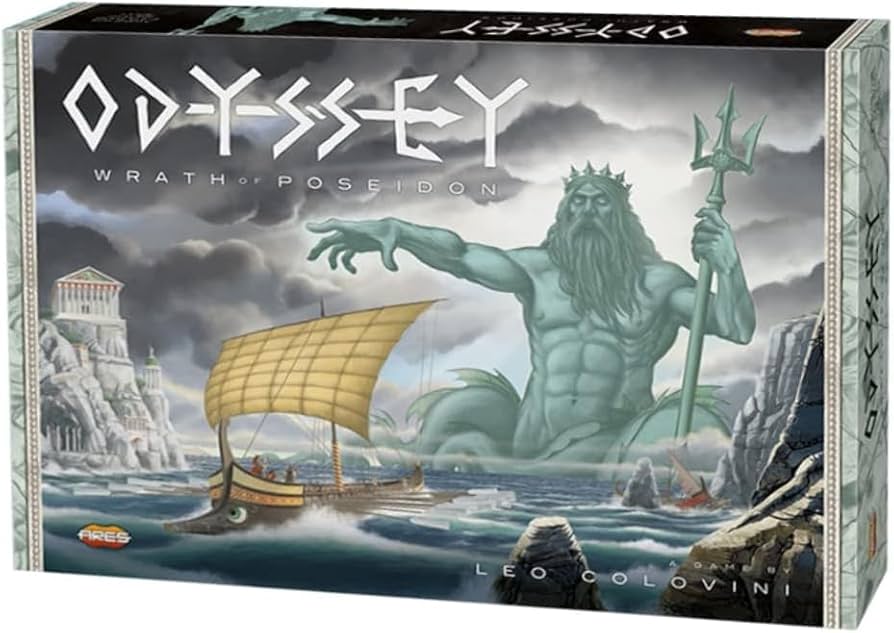
Released in 2015 by Ares Games and designed by Leo Colovini, Odyssey: Wrath of Poseidon offers a refreshing interpretation of Greek mythology that stands apart from many other mythological board games. Rather than focusing on famous heroes battling monsters or commanding legendary armies, the game explores one of the most compelling aspects of ancient Greek literature: the dangerous journey home after the Trojan War. Drawing its inspiration primarily from Homer’s Odyssey, the game places players in the role of Greek sailors attempting to navigate treacherous waters while the sea god Poseidon does everything in his power to prevent them from reaching safety.
This premise immediately sets the game apart. Greek mythology has inspired countless games filled with gods, monsters and epic combat, yet Odyssey: Wrath of Poseidon chooses a more subtle and authentic approach. Instead of turning Poseidon into a powerful enemy that players eventually defeat, the game presents him as an overwhelming force of nature. His influence is constant, unseen and deeply unsettling, just as he is portrayed in the ancient myths. The result is a board game that successfully combines hidden movement, deduction and teamwork into a tense experience where uncertainty is every bit as dangerous as mythical beasts.
Although the game typically lasts only around thirty minutes and features relatively straightforward rules, it captures many of the themes that have made Homer’s epic endure for nearly three thousand years. Every storm, every navigational error and every desperate attempt to locate the fleet reinforces the feeling that mortals are never fully in control when the gods become involved.
Gameplay Overview in Odyssey: Wrath of Poseidon
The story begins where many Greek legends leave off. The Trojan War has finally ended, and the victorious Greek fleets are preparing to return home after years of fighting. Their journey, however, is far from over. Before they can safely reach their kingdoms, they must first sail to the Sacred Island and offer prayers that may calm the anger of Poseidon.
One player assumes the role of Poseidon, while the remaining players control the Greek ships. A clever dual-board system separates what the navigators believe is happening from what is actually occurring. Poseidon secretly tracks the true positions of every vessel behind a screen, while the navigators only have access to their own imperfect understanding of where they are.
As the game progresses, Poseidon manipulates storms that gradually push the ships away from their intended routes. The navigators are forced to rely on landmarks, previous movements and careful reasoning to reconstruct their true positions. Unlike many adventure games that focus on combat or collecting resources, the central challenge here is deduction. Every decision becomes an exercise in interpreting incomplete information, making communication between the navigator players just as important as the movement of their ships.
The asymmetrical nature of the gameplay is one of its greatest strengths. Poseidon enjoys complete knowledge of the board but has limited opportunities to manipulate events, while the navigators possess freedom of movement but constantly struggle against uncertainty. The balance between these two roles creates tension throughout every session and ensures that both sides remain fully engaged.
A Brilliant Use of Hidden Information
Hidden information is a familiar mechanic in modern board gaming, but Odyssey: Wrath of Poseidon uses it in an unusually thematic manner. Rather than concealing cards or secret objectives, the game hides reality itself. The navigators can never be entirely certain where their ships truly are because Poseidon continually alters their course behind the scenes.
This simple concept creates remarkable psychological tension. Players begin questioning every assumption they make about the board. A familiar island may no longer be where they expect it to be. A route that seemed safe moments earlier may now lead directly into danger. Every movement requires players to reconsider their previous conclusions, producing a sense of uncertainty that perfectly reflects the experience of ancient sailors.
This mechanic is not simply clever from a gameplay perspective; it also reflects historical reality. Ancient Greek mariners possessed impressive navigational skills, but they lacked modern instruments that sailors now take for granted. Navigation depended upon the stars, coastal landmarks, prevailing winds and personal experience. Storms could easily drive even experienced captains off course, leaving them uncertain of their true position for days. The game’s central mechanic therefore recreates not only the mythology of the Odyssey but also the practical realities of Bronze Age seafaring.
Poseidon: The Perfect Antagonist
Few figures in Greek mythology are as perfectly suited to this style of game as Poseidon. Brother of Zeus and Hades, Poseidon ruled over the seas, earthquakes and horses, making him one of the three most powerful Olympian gods. Unlike Zeus, whose authority often centred on law and kingship, Poseidon embodied the unpredictable and often terrifying power of nature itself.
The sea represented both opportunity and danger for the ancient Greeks. It provided trade routes, food and exploration, yet it could also destroy entire fleets without warning. Poseidon reflected this duality. He was capable of granting calm seas and safe voyages, but he could just as easily unleash devastating storms against those who had offended him.
The board game captures this aspect of his personality remarkably well. Poseidon never attacks the Greek sailors directly. Instead, he alters the world around them, using storms and shifting currents to undermine their confidence and throw them off course. This mirrors Homer’s portrayal almost perfectly. Throughout The Odyssey, Poseidon’s vengeance rarely takes the form of direct confrontation. Instead, he ensures that every voyage becomes longer, every decision more difficult and every success temporary.
By making Poseidon an unseen manipulator rather than a conventional villain, the game preserves the feeling that mortals are struggling against forces far greater than themselves. It is a far more authentic interpretation of Greek mythology than simply giving the sea god extraordinary combat abilities.
Homer’s Odyssey as the Main Inspiration
The influence of Homer’s Odyssey is immediately obvious, both in the game’s title and its central narrative. The epic poem tells the story of Odysseus’ ten-year struggle to return home following the fall of Troy. Although he survives the war itself, his greatest challenges begin only after victory has already been achieved.
The reason for his suffering lies with Poseidon. After blinding the Cyclops Polyphemus, Odysseus unknowingly earns the hatred of the Cyclops’ divine father. Poseidon responds with relentless vengeance, scattering Odysseus’ fleet through violent storms, wrecking ships and ensuring that every step towards Ithaca is met with another setback.
Odyssey: Wrath of Poseidon captures this central idea without attempting to recreate every episode of Homer’s epic. Players are not asked to fight the Cyclops, escape Circe or sail past Scylla and Charybdis. Instead, they experience the underlying emotional journey that defines the poem: the constant frustration of trying to reach home while an immortal god repeatedly interferes.
This focus on the voyage itself makes the game feel surprisingly faithful to its literary inspiration. Rather than adapting isolated scenes, it recreates the mood and themes that make the Odyssey one of the greatest works of ancient literature.
Why the Sacred Island Matters
One of the game’s primary objectives is reaching the Sacred Island to offer sacrifices that may appease Poseidon. This objective reflects genuine religious practices in the ancient Greek world.
The Greeks believed that maintaining a proper relationship with the gods was essential for success in every aspect of life. Before embarking on dangerous voyages, sailors commonly visited temples dedicated to Poseidon to seek his favour. Offerings of animals, wine, olive oil and incense formed an important part of these rituals, and neglecting such obligations was considered both dangerous and disrespectful.
Throughout Greek mythology, heroes frequently perform sacrifices before setting out on important journeys or after surviving great dangers. Success depended not only upon courage and intelligence but also upon divine goodwill. By making prayer rather than conquest the game’s ultimate objective, Odyssey: Wrath of Poseidon reflects this belief with impressive accuracy.
The Sacred Island therefore represents reconciliation rather than victory. Players are not attempting to overthrow Poseidon but instead hope to restore harmony between mortals and the divine.
The Importance of the Sea in Greek Civilization
To fully appreciate the game’s setting, it is important to understand the significance of the sea in ancient Greek life. Greece’s mountainous landscape made overland travel difficult, while its extensive coastline encouraged trade, exploration and colonisation by sea. Ships connected hundreds of city-states scattered across the Aegean and Mediterranean, allowing commerce, culture and ideas to spread throughout the ancient world.
Because maritime travel was so essential, Poseidon occupied a central place in Greek religion. Temples dedicated to him overlooked harbours and coastlines, while sailors regularly sought his blessing before embarking on dangerous voyages. Naval commanders and merchants alike recognised that favourable weather could determine the success or failure of their expeditions.
The game reflects these historical realities remarkably well. The uncertainty experienced by players mirrors the genuine risks faced by ancient sailors, who constantly battled changing winds, powerful currents and unpredictable storms. Even without mythical intervention, the sea was an unforgiving environment, and the Greeks naturally viewed its dangers as expressions of Poseidon’s immense power.
The Trojan War Connection
The game’s story begins immediately after the Trojan War, a period that occupies an important place within Greek mythology. Although the Greeks ultimately succeeded in capturing Troy after ten years of conflict, many of the victorious heroes discovered that returning home would prove every bit as difficult as winning the war itself.
Ancient Greek literature even gave these troubled homecomings their own collective name: the Nostoi, meaning “Returns.” Odysseus became the most famous example because of Homer’s epic, but he was far from alone. Agamemnon was murdered shortly after reaching Mycenae, Menelaus wandered the Mediterranean for years before returning to Sparta, and Ajax the Lesser met a disastrous end after offending the gods.
These stories illustrate one of the recurring lessons of Greek mythology: victory does not guarantee happiness. Heroes who displayed arrogance, ignored religious obligations or offended the gods often found that success on the battlefield offered little protection from divine punishment. Odyssey: Wrath of Poseidon embraces this idea by reminding players that the greatest challenge begins only after the war has already been won.
The Theme and Mechanics Work Together
One of the most impressive aspects of Odyssey: Wrath of Poseidon is the way its mechanics reinforce its narrative. Too many mythology-themed games simply rename familiar mechanics after famous gods without allowing the mythology itself to influence the gameplay. Here, every major system contributes directly to the story being told.
The hidden boards represent uncertainty at sea, while Poseidon’s secret manipulation of the fleet captures the unpredictable nature of divine intervention. Communication between the navigators reflects the constant discussions that would have taken place among ancient captains attempting to determine their position, and the asymmetrical roles perfectly express the unequal relationship between immortal gods and vulnerable human beings.
As a result, players often find themselves creating memorable stories naturally during play. A ship that narrowly avoids disaster feels like another episode from Homer’s epic, while an incorrect deduction leading the fleet further into danger evokes the endless frustration experienced by Odysseus himself. This harmony between theme and mechanics gives the game a level of immersion that many larger and more expensive mythology games struggle to achieve.
Production Quality
Although Odyssey: Wrath of Poseidon is not filled with elaborate miniatures or lavish components, its production values remain impressive. Francesco Mattioli’s artwork successfully evokes the atmosphere of classical Greece without becoming cluttered, while the miniature ships are attractive and easy to distinguish during play. The twin-board system is particularly well designed and forms the heart of the game’s unique mechanics.
Everything inside the box serves a practical purpose, reflecting a philosophy that values elegant design over unnecessary extravagance. The result is a visually appealing game whose presentation supports its gameplay rather than distracting from it.
Strengths
Perhaps the game’s greatest strength is the originality of its design. The asymmetrical roles ensure that every participant experiences the game differently, and the deduction-based gameplay remains engaging long after players have become familiar with the rules. Most importantly, the mythology feels genuinely integrated into every aspect of the experience rather than existing as decorative background.
The relatively short playing time is another advantage, allowing the game to deliver meaningful strategic decisions without overstaying its welcome. It is easy to teach, accessible to newcomers and distinctive enough to stand out among modern mythology-themed board games.
Weaknesses
The same qualities that make the game unique may also limit its audience. Players expecting heroic battles, monster encounters or large-scale strategic warfare may be surprised by its quieter, more thoughtful focus on deduction and navigation. Much of the excitement comes from reasoning through incomplete information rather than dramatic action, and this style of gameplay will naturally appeal more to some groups than others.
The hidden information can also be intimidating during early games, as inexperienced players may struggle to reconstruct the fleet’s true position after several turns of movement. Fortunately, the game includes optional variants that help reduce the difficulty, allowing new players to become comfortable with the system before attempting the full challenge.
Odyssey: Wrath of Poseidon
Odyssey: Wrath of Poseidon remains one of the hidden gems among Greek mythology board games. Rather than relying on spectacular monsters, heroic combat or cinematic storytelling, it embraces the quieter but no less compelling struggle that lies at the heart of Homer’s Odyssey: humanity’s attempt to survive an indifferent and often hostile sea while enduring the unpredictable will of the gods.
Leo Colovini has created a game that understands Greek mythology at a deeper level than many larger productions. Poseidon is not merely an enemy to defeat but a symbol of the immense natural forces that shaped ancient Greek life. Every storm, every navigational error and every moment of uncertainty reminds players that courage alone is not always enough when divine powers intervene.
For anyone interested in Greek mythology, ancient history or innovative board game design, Odyssey: Wrath of Poseidon offers a thoughtful and highly thematic experience. It successfully transforms one of Western literature’s greatest epics into an engaging tabletop adventure that captures both the spirit of Homer’s poetry and the historical realities of life on the ancient Mediterranean. More than a decade after its release, it remains an overlooked classic whose elegant mechanics and faithful use of mythology continue to reward players willing to brave Poseidon’s wrath. For more info visit the official websites of Ares Games.
Discover more from Hellenic Moon
Subscribe to get the latest posts sent to your email.