Hadestown: The Musical extends run in cinema
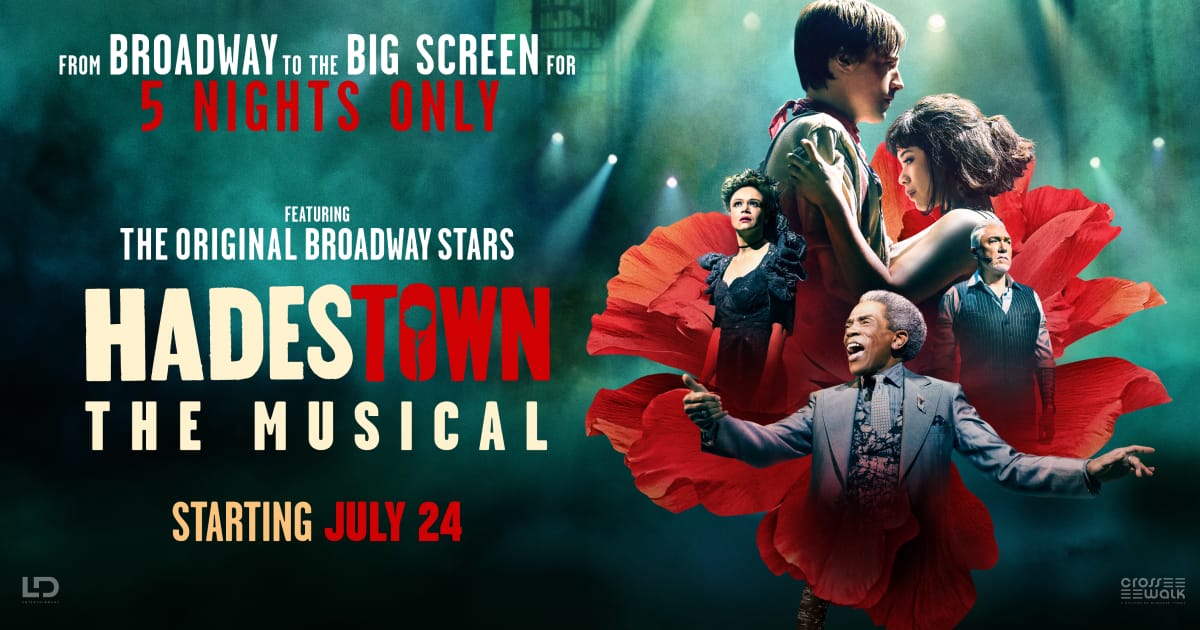
After years of captivating audiences on Broadway and in London’s West End, Hadestown: The Musical has finally made the leap to the big screen. Rather than adapting the show into a traditional Hollywood movie, the 2026 cinema release presents a professionally filmed version of the acclaimed stage production, allowing audiences worldwide to experience Anaïs Mitchell’s modern masterpiece in cinemas. The film captures the original Broadway principal cast reunited during a special London engagement, preserving one of the most celebrated musicals of the twenty-first century for future generations. You can find tickets to the show here.
For theatre fans, the cinema release offers the opportunity to see performances that have become legendary. For newcomers, it serves as an accessible introduction to one of Greek mythology’s greatest love stories. The musical has won multiple Tony Awards, including Best Musical, and has become renowned for combining American folk music, New Orleans jazz, blues, and poetic storytelling with some of the oldest myths ever written.
What makes Hadestown particularly remarkable is that it does not simply retell Greek mythology. Instead, it reimagines these ancient stories through a modern lens, exploring themes of economic inequality, environmental decline, political power, hope, and the resilience of love. The result is a timeless story that feels as relevant today as it did over two thousand years ago.
Originally they only wanted to run Hadestown in the cinema for 5 days, but due to the popularity of the show, the cinema run was extended indefinitely, to give everyone a chance to see it at the cinema!
From Stage to the Big Screen
Unlike many stage musicals that are transformed into cinematic adaptations with new actors and locations, Hadestown: The Musical remains faithful to its theatrical roots. Directed for the screen by Brett Sullivan, the film captures live performances from the West End production while taking advantage of cinematic techniques that allow viewers to see every expression, movement, and emotional moment up close.
The production reunites the original Broadway cast, including Reeve Carney as Orpheus, Eva Noblezada as Eurydice, Patrick Page as Hades, Amber Gray as Persephone, and André De Shields as Hermes. Their performances have become synonymous with these roles, making the cinema release feel less like a recording and more like a definitive preservation of the musical.
The move to cinemas also broadens the show’s audience. Many theatre lovers never had the opportunity to travel to Broadway or London, and tickets for the live production have often been difficult to obtain. The cinema release allows audiences around the world to experience the production while maintaining the atmosphere and energy of live theatre. We have an old blog post about how Hadestown won the Best-Long Running Broadway show award.
The Ancient Story of Orpheus and Eurydice
At the heart of Hadestown lies one of Greek mythology’s most tragic romances: the story of Orpheus and Eurydice.
According to ancient Greek myth, Orpheus was the greatest musician who ever lived. He was often described as the son of either the god Apollo or the Thracian king Oeagrus, while his mother was usually the Muse Calliope, patron of epic poetry. His musical abilities were so extraordinary that wild animals gathered to hear him play, rivers altered their course, and even stones moved in response to his songs.
His beloved Eurydice was a beautiful nymph. Shortly after their wedding, tragedy struck when she died from a venomous snake bite while fleeing danger. Devastated by grief, Orpheus decided to attempt the impossible: travelling alive into the Underworld to bring her back.
His music proved so beautiful that every creature in the realm of the dead stopped to listen. Even the Furies were moved to tears, while Hades and Persephone, rulers of the Underworld, agreed to release Eurydice under one condition.
Orpheus would walk ahead, and Eurydice would follow him back to the world of the living. However, he must not look back until they had both reached the surface.
As they climbed toward daylight, doubt began to consume him. Just before reaching safety, Orpheus turned to see whether Eurydice was truly behind him. In that instant she vanished forever, returning to the Underworld.
This heartbreaking ending has made the myth one of the defining tragedies of Greek literature, symbolising the fragile nature of hope and the destructive power of uncertainty.
A Modern Reimagining of the Myth
While Hadestown preserves the central outline of Orpheus’ journey, Anaïs Mitchell transforms nearly every surrounding detail.
Instead of depicting ancient Greece, the musical creates an industrial world inspired by the American Depression, New Orleans, and early twentieth-century labour culture. The Underworld is no longer merely the kingdom of the dead—it becomes a vast factory where exhausted workers endlessly build walls under Hades’ command.
This setting introduces contemporary social commentary without abandoning the mythological foundation. Hades represents not only the god of the dead but also an authoritarian industrial magnate who promises security in exchange for freedom.
Likewise, Orpheus’ legendary music becomes the power of artistic imagination. Rather than wielding swords or supernatural powers, he fights oppression with songs capable of changing hearts.
The result is a version of Greek mythology that feels surprisingly modern while remaining deeply respectful of its ancient origins.
Hades: More Than the Villain
Popular culture often portrays Hades as the Greek equivalent of Satan, but Greek mythology presents a far more nuanced figure.
Hades was one of the three sons of Cronus and Rhea. After the Titanomachy, he and his brothers Zeus and Poseidon divided the cosmos. Zeus ruled the heavens, Poseidon governed the sea, and Hades became lord of the Underworld.
Importantly, Hades was not evil. His responsibility was maintaining order among the dead and ensuring that the natural cycle of life and death continued uninterrupted.
Hadestown preserves this complexity. Patrick Page’s Hades is intimidating, controlling, and emotionally distant, yet he is also deeply lonely. His harsh rule is motivated by fear—fear of losing Persephone, fear of change, and fear that love itself cannot be trusted.
This psychological interpretation makes Hades a far more sympathetic character than many earlier adaptations.
Persephone and the Changing Seasons
The second major myth woven into Hadestown concerns Persephone.
In Greek mythology, Persephone was the daughter of Demeter, goddess of agriculture. She was abducted by Hades and taken to the Underworld as his wife.
Demeter’s grief caused crops to fail and winter to spread across the earth. Eventually Zeus negotiated Persephone’s partial return.
However, because Persephone had eaten pomegranate seeds in the Underworld, she was required to spend part of every year with Hades and the remainder with her mother.
The Greeks used this myth to explain the changing seasons. Spring and summer arrived when Persephone returned to Demeter, while autumn and winter began when she descended once more into the Underworld.
Hadestown builds upon this mythology by portraying Persephone as increasingly unhappy with life below ground. Her annual return to the surface brings warmth, music, and joy, while her departure allows Hades’ industrial kingdom to tighten its grip.
The strained marriage between Hades and Persephone mirrors the developing relationship between Orpheus and Eurydice, creating two parallel love stories that examine trust from different perspectives.
Hermes: The Storyteller
Hermes plays an especially important role in the musical.
In Greek mythology, Hermes served as messenger of the gods, patron of travellers, merchants, thieves, and communication. He also guided souls safely into the Underworld, earning the title Psychopomp.
Because Hermes could freely travel between the worlds of the living and the dead, he becomes the perfect narrator for Hadestown. Rather than acting as a distant observer, he introduces the audience to the story, comments on events, and reminds everyone that this is an ancient tale told again and again.
This storytelling approach reflects the oral traditions through which Greek myths survived for centuries before eventually being written down.
The Three Fates
Another important mythological element is the appearance of the Fates.
Known as the Moirai in Greek mythology, these three divine sisters controlled the destiny of every mortal.
Clotho spun the thread of life.
Lachesis measured its length.
Atropos cut the thread when life came to an end.
Even Zeus rarely interfered with their decisions.
In Hadestown, the Fates function as voices of anxiety, temptation, and self-doubt. Rather than physically controlling destiny, they whisper possibilities into the minds of Orpheus and Eurydice, encouraging fear and uncertainty.
This psychological interpretation reflects a modern understanding of fate while preserving the ancient idea that human beings constantly struggle against forces beyond their control.
Music as Divine Power
Music occupies a sacred place in Greek mythology.
Apollo represented music, poetry, and harmony, while the Muses inspired every form of artistic creation.
Orpheus embodied these divine gifts more completely than any mortal. His music could tame wild beasts, calm rivers, and soften even the hearts of immortal gods.
Hadestown places music at the centre of its storytelling. Every major turning point occurs through song rather than physical conflict.
Orpheus’ compositions become acts of resistance against oppression. His melodies remind Hades of the love he once shared with Persephone, demonstrating that beauty can challenge even absolute power.
This reflects an important Greek belief that art possesses transformative and even sacred qualities.
Hope, Trust, and Human Nature
Perhaps the greatest strength of Hadestown is its understanding of why Greek myths continue to matter.
The original myth of Orpheus has often been interpreted as a warning about impatience or disobedience.
The musical expands this interpretation into something broader. Orpheus does not fail simply because he looks back. He fails because fear overcomes trust.
Similarly, Hades builds walls because he fears losing Persephone. Eurydice accepts security because she fears hunger. Nearly every major decision is driven by uncertainty rather than confidence.
These emotional struggles remain immediately recognisable today, making the ancient myths surprisingly contemporary.
Why Greek Mythology Still Resonates
Greek mythology has survived for over two millennia because it explores universal human experiences rather than simply recounting supernatural adventures.
Love, grief, ambition, jealousy, sacrifice, loyalty, and hope remain just as meaningful today as they were in ancient Athens.
Hadestown demonstrates how these myths can evolve without losing their essential truths. By combining ancient stories with modern music and social commentary, it reveals that mythology is not a collection of outdated legends but a living tradition that continues to inspire new generations.
Rather than treating the myths as distant historical curiosities, the musical encourages audiences to recognise themselves within these characters.
Hadestown: The Musical
The cinema release of Hadestown marks an important moment for both musical theatre and Greek mythology. It preserves one of Broadway’s most acclaimed productions while making it accessible to audiences far beyond New York or London. The filmed performance retains the energy of live theatre while using cinema to create an intimate experience that allows viewers to appreciate every emotional nuance.
More importantly, Hadestown demonstrates the enduring power of Greek myth. Through Orpheus and Eurydice, Hades and Persephone, Hermes, and the Fates, the musical reminds us that these ancient stories continue to illuminate modern concerns about love, power, inequality, hope, and the choices that define our lives.
Like the storytellers of ancient Greece, Hadestown invites us to hear a familiar tale once more. We already know how it ends, yet we continue listening because each retelling reveals something new. In doing so, the musical honours the spirit of Greek mythology itself—a tradition that has always evolved with each generation while preserving the timeless questions at its heart.
Discover more from Hellenic Moon
Subscribe to get the latest posts sent to your email.