Iliad, the board game by Reiner Knizia
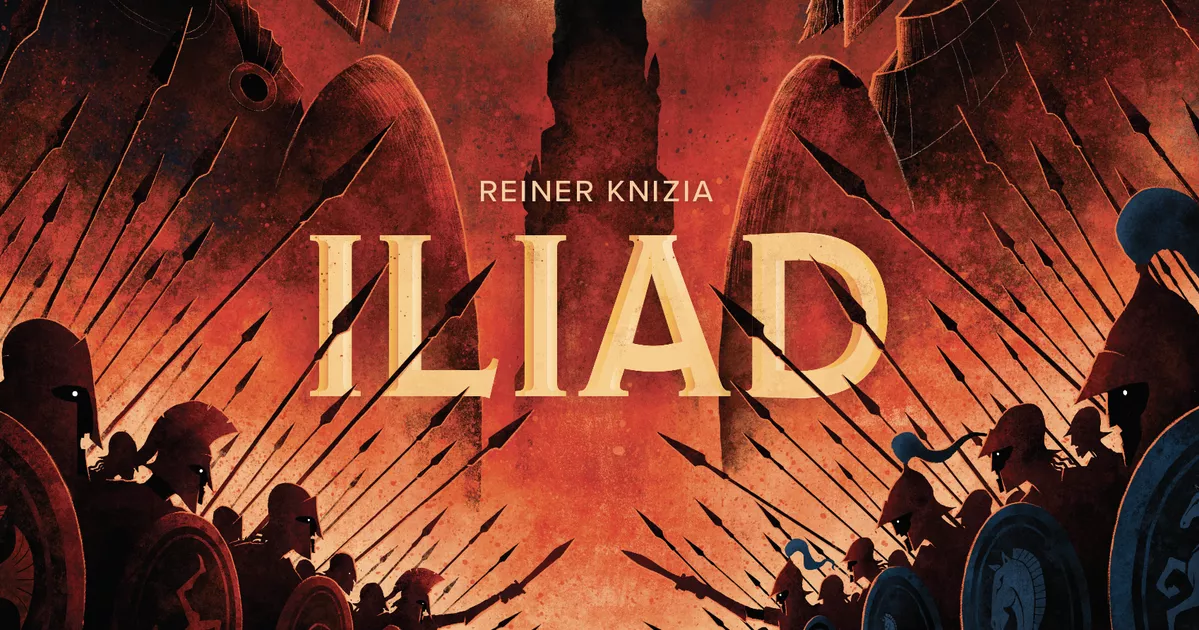
As we prepare for Christopher Nolan’s version of Homer’s Odyssey coming out in 2 weeks, lets take a step back and talk about the prequel of Homer’s Odyssey: Homer’s Iliad.
Few stories have shaped Western literature as profoundly as Homer’s Iliad. Written nearly 2,800 years ago, the epic poem recounts a small but decisive period during the final year of the Trojan War, focusing not simply on armies and battles, but on pride, honour, destiny, and the relationship between mortals and the gods. It has inspired countless novels, films, television series, and video games, and now it provides the backdrop for one of the finest recent two-player board games.
Designed by renowned German game designer Reiner Knizia, Iliad transforms one of history’s greatest literary epics into a tense thirty-minute tactical duel. Rather than attempting to recreate every battle of the Trojan War, Knizia wisely concentrates on its central themes: two legendary heroes competing for glory while the Olympian gods influence the outcome from above. The result is an elegant strategy game that feels both timeless and surprisingly modern.
Like many of Knizia’s greatest works, Iliad proves that brilliant game design does not require complicated rules. Every decision matters, every tile placement creates new possibilities, and the battle remains uncertain until the final moments. Although its mechanics are largely abstract, the mythology gives every move additional meaning, encouraging players to imagine themselves as Achilles or Hector fighting beneath the walls of Troy.
A Duel Between Legendary Heroes in Reiner Knizia’s Iliad
Unlike many games based on the Trojan War that attempt to recreate massive armies and sprawling campaigns, Iliad focuses on the personal rivalry between two of mythology’s greatest warriors.
One player assumes the role of Achilles, the greatest champion of the Greek forces. The other commands Hector, prince of Troy and defender of his city. Their conflict represents the emotional climax of Homer’s epic, where two warriors carrying the hopes of entire civilizations meet in single combat.
Gameplay unfolds on a compact grid where players alternate placing numbered tiles, each representing military strength and tactical opportunities. Rows and columns eventually score, rewarding players with valuable success tokens that represent either points or, more importantly, the favour of individual gods.
This creates a fascinating tension. Is it better to pursue straightforward victory through points, or should players concentrate on earning the exclusive support of the Olympian deities? That dual victory condition is one of the game’s most ingenious ideas and forces meaningful choices throughout the match.
Elegant Design in the Classic Knizia Style
Reiner Knizia has designed hundreds of games over the past three decades, including classics such as Lost Cities, Modern Art, Ra, and Samurai. His hallmark is extracting remarkable strategic depth from remarkably simple systems.
Iliad exemplifies this philosophy.
Each player possesses an identical collection of tiles ranging in strength from one to five, alongside special Dolos tiles whose strength depends upon neighbouring enemy pieces. Most numbered tiles also include optional special abilities, allowing players to reposition or manipulate the battlefield.
Because both players have exactly the same resources, victory depends almost entirely upon timing, positioning, and tactical awareness rather than luck. Random tile draws introduce uncertainty, but each decision feels significant because every placement changes multiple future scoring opportunities.
The game typically finishes in around thirty minutes, making it exceptionally replayable. It captures the satisfying feeling of a game of chess while remaining far easier to learn and considerably faster to complete. Reviewers have consistently praised its combination of accessibility and surprising depth.
The Greek Mythology Behind the Game
To appreciate Iliad, it helps to understand the myths that inspired it.
According to Greek mythology, everything began with a wedding.
The sea goddess Thetis married the mortal king Peleus. During the celebrations, Eris, goddess of discord, was deliberately not invited. Angered by the insult, she threw a golden apple among the guests inscribed “For the Fairest.”
Three goddesses immediately claimed it: Hera, Athena, and Aphrodite.
Unable to settle the dispute, Zeus appointed the Trojan prince Paris to judge their beauty. Each goddess attempted to bribe him.
Hera offered political power.
Athena promised military victory and wisdom.
Aphrodite offered the love of the world’s most beautiful woman, Helen.
Paris chose Aphrodite.
Unfortunately, Helen was already married to Menelaus, king of Sparta.
Paris travelled to Greece and returned to Troy with Helen, either abducting or persuading her to leave depending on the version of the myth. Menelaus appealed to the other Greek kings, who had sworn an oath to protect Helen’s marriage. Under the leadership of Agamemnon, they assembled one of mythology’s greatest armies and sailed to Troy.
Thus began the famous Trojan War.
The conflict lasted ten years before eventually ending with the famous Trojan Horse, although Homer’s Iliad does not actually describe the horse itself. Instead, the poem focuses on only a few weeks during the final year of fighting.
Achilles: Greece’s Greatest Hero
Achilles occupies the centre of Homer’s poem and naturally serves as one of the game’s two heroes.
His mother, Thetis, attempted to make him immortal by dipping him into the River Styx. She held him by one heel, leaving that single spot vulnerable. This story gave rise to the modern phrase “Achilles’ heel,” describing someone’s one fatal weakness.
Achilles possessed unmatched speed, strength, and combat ability. No Trojan warrior could defeat him fairly.
Yet Homer’s Iliad begins not with battle but with anger.
Achilles quarrels with Agamemnon after the Greek leader takes away his war prize, Briseis. Feeling dishonoured, Achilles refuses to fight.
Without their greatest champion, the Greeks begin losing the war.
Only after his closest companion, Patroclus, is killed by Hector does Achilles return to battle. Consumed by grief and rage, he defeats Hector in one of literature’s most famous duels.
Although Iliad the board game abstracts these events, every tactical move can be imagined as part of Achilles’ relentless pursuit of glory and vengeance.
Hector: The Noble Defender of Troy
Equally important is Hector, one of mythology’s most admired heroes.
Unlike Achilles, Hector fights not for personal glory but for his family, his people, and his homeland.
He is portrayed as a devoted husband to Andromache and a loving father to their infant son Astyanax. His scenes with his family remain among the most emotional passages in all ancient literature because Hector understands he will probably die defending Troy.
Nevertheless, duty outweighs fear.
When Hector finally confronts Achilles, he knows the odds are against him, yet he refuses to abandon his responsibilities.
His courage transforms him into one of mythology’s greatest tragic heroes.
In many ways, modern readers often sympathize more with Hector than Achilles because his motivations are fundamentally selfless.
That moral complexity gives the board game additional thematic richness. Players are not simply moving coloured tiles but representing two completely different ideals of heroism.
The Gods Never Stop Interfering
Perhaps the most distinctive feature of Homer’s Iliad is the constant involvement of the Olympian gods.
Unlike many modern retellings, divine intervention is not symbolic.
The gods physically enter battles, rescue warriors, deceive armies, and influence countless events.
Zeus attempts to maintain cosmic balance while allowing fate to unfold.
Athena strongly supports the Greeks because Paris rejected her during the Judgment.
Hera also favours Greece for the same reason.
Aphrodite protects Paris and the Trojans after receiving his judgment.
Apollo repeatedly aids Troy by shielding Hector and attacking Greek forces.
Ares, god of war, changes sides throughout the conflict depending upon circumstance.
The board game cleverly represents this divine involvement through its god-favour system. Players are rewarded for securing the exclusive support of multiple Olympian gods rather than merely accumulating military strength.
Mechanically, this creates an additional strategic objective.
Thematically, it perfectly captures one of the central messages of Greek mythology: human courage alone is rarely enough without divine favour.
An Abstract Game with a Strong Theme
Some critics describe Iliad as essentially an abstract strategy game wearing mythological clothing.
There is truth in this observation.
The mechanics could theoretically represent almost any conflict.
Yet the Trojan War theme works remarkably well because its emphasis is psychological rather than historical.
Players experience continual tension over territory, positioning, timing, sacrifice, and divine influence—all ideas deeply rooted in Homer’s epic.
The artwork reinforces this atmosphere with dramatic depictions of warriors, gods, and ancient Greece. Rather than overwhelming players with historical detail, it evokes the emotional weight of myth.
Many reviewers have praised how effectively the presentation communicates the brutality and grandeur of the legendary conflict despite the game’s elegant simplicity.
Strengths and Minor Weaknesses
The game’s greatest achievement is how much strategy emerges from so few rules.
Every turn presents meaningful choices. Should you strengthen an existing line? Disrupt your opponent? Pursue another god’s favour? Prepare for future scoring? Sacrifice immediate points for a better endgame?
Because both players share identical resources, victories feel earned.
The short playing time also encourages immediate rematches, with each game revealing fresh tactical possibilities.
Another major strength is accessibility. New players can learn the rules quickly, while experienced gamers discover increasingly subtle interactions over repeated plays.
There are only a few minor drawbacks.
Some players may wish the Trojan War theme were integrated even more deeply into the mechanics. Unlike narrative adventure games, Iliad does not recreate famous scenes from Homer or tell an unfolding story.
Luck also plays a modest role through tile draws. Although skilled players generally outperform beginners, occasional frustration may arise when desired tiles appear later than expected. Several reviewers have noted that this randomness adds tension but may disappoint players seeking a completely deterministic abstract strategy game.
Reiner Knizia’s Iliad
Iliad demonstrates why Reiner Knizia remains one of the most respected board game designers in the world. It strips away unnecessary complexity while preserving meaningful strategic depth, resulting in a game that feels simultaneously ancient and modern.
Its connection to Greek mythology is more than decorative. By centring the struggle between Achilles and Hector and making divine favour an essential path to victory, the game captures some of the defining themes of Homer’s masterpiece: honour, fate, courage, and the unpredictable influence of the gods.
Fans of Greek mythology will appreciate the careful respect shown toward the source material, while strategy enthusiasts will discover one of the finest recent two-player tactical games. It rewards repeated play without becoming overwhelming, making it equally suitable for newcomers and experienced hobby gamers.
Ultimately, Iliad succeeds for the same reason Homer’s epic has endured for nearly three millennia. Both tell stories in which every choice carries weight, every victory comes at a cost, and glory is never guaranteed. The board game may compress a legendary ten-year war into thirty minutes, but it preserves the essential spirit of one of humanity’s greatest myths with remarkable elegance. Go to the official website of Bitewing Games for more info.
Discover more from Hellenic Moon
Subscribe to get the latest posts sent to your email.