Aeon Trespass: Odyssey (2022 board game)
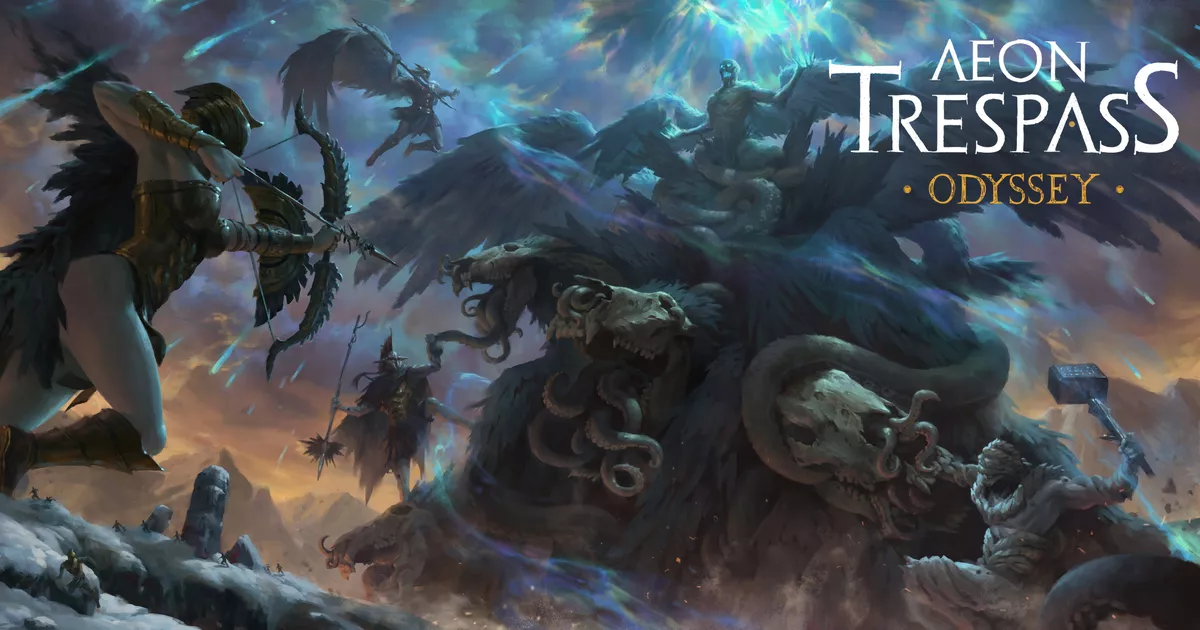
Few board games have attempted to capture the scale and grandeur of ancient Greek mythology quite like Aeon Trespass: Odyssey. Developed by Into the Unknown, this enormous cooperative campaign game combines tactical boss battles, narrative exploration, civilization building, and branching storytelling into an experience that can easily exceed 300 hours. Rather than simply retelling famous myths, the game creates an alternative version of Ancient Greece where science, myth, and cosmic horror collide.
At first glance, Aeon Trespass: Odyssey appears to be a game about giant monsters and towering mechanical Titans. However, beneath its spectacular miniatures lies a remarkably thoughtful interpretation of Greek mythology. Nearly every aspect of the game—from its characters and locations to its themes of fate, heroism, hubris, and divine punishment—draws inspiration from classical legends. Instead of treating mythology as background decoration, the designers reimagine familiar stories in ways that feel both respectful and refreshingly original.
For players who enjoy rich storytelling and deep strategic gameplay, Aeon Trespass: Odyssey offers one of the most ambitious mythological board game experiences ever created.
A Different Ancient Greece
The world of Aeon Trespass is recognizably Greek, but it is not historical Greece. It is an alternate reality where advanced technology exists alongside legendary monsters, and where humanity stands on the brink of extinction.
The story begins after a catastrophic event has shattered the established order of the world. The Olympian gods have fallen, reality itself has become unstable, and terrifying Primordials roam the land. Rather than relying on divine intervention, humanity must now survive using ancient technology and massive biomechanical constructs known as Titans.
Players take on the role of Argonauts aboard the enormous city-ship Argo. As they sail across the seas and travel through dangerous lands, they uncover forgotten civilizations, confront impossible monsters, and gradually discover the truth behind the world’s collapse.
This setting immediately distinguishes itself from traditional Greek mythology. Instead of simply fighting Medusa or the Minotaur, players explore what the Greek world might look like after the gods themselves have disappeared.
Aeon Trespass: Odyssey – How the Game Works
Although its story receives much of the attention, Aeon Trespass: Odyssey is also one of the most mechanically complex campaign games ever published.
The gameplay revolves around three interconnected phases.
Voyage Phase
During the Voyage Phase, players command the mighty Argo across a large campaign map. They choose where to travel, gather resources, discover new regions, and trigger story events.
Unlike many campaign games that simply move players between combat encounters, every journey in Aeon Trespass feels meaningful. Exploration often leads to moral decisions, unexpected discoveries, or dangerous encounters that permanently alter future chapters.
Managing the Argo itself also becomes increasingly important. The crew researches technologies, constructs new facilities, develops equipment, and strengthens their civilization while deciding how to allocate limited resources.
Adventure Phase
Whenever the crew reaches important locations, the game transitions into narrative adventures.
These sections function almost like a choose-your-own-adventure novel. Players speak with characters, investigate ruins, negotiate with rival factions, solve mysteries, and make decisions that influence later events.
Choices rarely have obvious right answers. Saving one settlement might doom another. Trusting an ally could eventually lead to betrayal. These branching narratives encourage replayability while reinforcing one of Greek mythology’s central ideas: every decision carries consequences.
Battle Phase
Combat forms the centrepiece of the experience.
Instead of controlling individual heroes, players command gigantic Titans against equally enormous Primordials. Battles resemble cinematic clashes between gods and monsters rather than traditional dungeon crawls.
Each Primordial possesses its own artificial intelligence deck, attack patterns, and evolving behaviour. As the fight progresses, enemies adapt, become more dangerous, and unlock devastating new abilities.
One particularly innovative mechanic is the game’s “Inverted Combat Paradigm.” Rather than becoming weaker as damage accumulates, Titans often gain access to stronger abilities the closer they come to defeat. Combat therefore becomes increasingly desperate and dramatic, perfectly capturing the feeling of mythological heroes fighting impossible battles through sheer determination.
Titans and Primordials
The Titans are perhaps the game’s most distinctive feature.
Although their name comes directly from Greek mythology, the Titans of Aeon Trespass are not simply the divine beings from Hesiod’s Theogony. Instead, they are colossal living war machines that human Argonauts pilot into battle.
This reinterpretation cleverly blends mythology with science fiction. Rather than replacing mythology, it imagines what legendary Titans might become in a technologically advanced version of ancient Greece.
Their opponents, the Primordials, draw inspiration from the primordial deities that existed before the Olympian gods. In Greek mythology, beings such as Chaos, Gaia, Tartarus, Nyx and Pontus represented fundamental forces of existence rather than ordinary monsters.
Aeon Trespass expands this concept dramatically. Its Primordials feel less like animals and more like walking natural disasters—ancient entities that embody terrifying cosmic powers.
Battles against them resemble clashes between civilization itself and the untamed forces of creation.
The Argo and the Argonauts
Perhaps the clearest mythological reference is the player’s home.
The Argo is one of the most famous ships in Greek mythology. According to legend, Jason and the Argonauts sailed aboard it in search of the Golden Fleece.
Aeon Trespass transforms the famous vessel into an enormous moving city capable of supporting an entire civilization. Instead of carrying a few dozen heroes, this Argo serves as humanity’s last great stronghold.
Likewise, the player characters are known as Argonauts.
This immediately establishes their role within the story. Like Jason’s companions, they are explorers venturing into unknown lands filled with monsters, mysteries, and divine dangers.
The game repeatedly reinforces the idea that every expedition echoes the legendary voyage of the original Argonauts.
The Influence of Greek Heroic Tradition
Greek heroes rarely achieved victory because they were invincible.
Instead, heroes such as Achilles, Odysseus, Perseus, and Heracles succeeded through courage, intelligence, sacrifice, and perseverance despite overwhelming odds.
Aeon Trespass embraces this philosophy.
The campaign constantly places players in situations where success feels uncertain. Resources become scarce. Allies die. Titans suffer permanent damage. Story decisions create painful consequences.
Victory often comes at considerable cost.
Rather than presenting flawless superheroes, the game encourages players to become tragic heroes whose greatest victories are inseparable from suffering.
This mirrors classical Greek literature remarkably well.
Fate and Destiny
No concept is more central to Greek mythology than fate.
Even Zeus, king of the gods, could not always escape destiny. Heroes frequently learned that avoiding prophecy merely fulfilled it.
Aeon Trespass repeatedly explores these same ideas.
Throughout the campaign, players encounter prophecies, mysterious visions, ancient secrets, and seemingly inevitable catastrophes. Decisions matter enormously, yet many events appear destined long before the characters understand them.
The tension between free will and predetermined destiny creates much of the game’s dramatic power.
Players constantly wonder whether they are changing history—or merely walking the path that fate has already chosen.
Hubris
One of the defining moral lessons of Greek mythology concerns hubris—the dangerous arrogance of believing oneself equal to the gods.
Characters such as Icarus, Niobe, Arachne, Pentheus, and King Midas all suffer because they overestimate their own power.
Aeon Trespass explores hubris on a civilization-wide scale.
Humanity attempts to replace divine authority with technology. It creates Titans powerful enough to challenge ancient beings. Scientific progress pushes beyond traditional limits.
The question becomes whether humanity is saving the world—or repeating the very mistakes that caused its destruction.
This ambiguity makes the narrative far richer than a simple battle between good and evil.
The Labyrinth
Among the game’s many mythological inspirations, the Labyrinth occupies an especially important place.
The myth of King Minos, Daedalus, and the Minotaur remains one of Greece’s greatest stories. The Labyrinth represents confusion, imprisonment, fear, and hidden truth.
Aeon Trespass reimagines the Labyrinth as something far more mysterious than merely an underground maze.
It becomes both a physical location and a symbolic representation of reality itself—complex, unknowable, and filled with secrets waiting to be uncovered.
Players gradually realise that escaping the Labyrinth requires more than defeating monsters. It demands understanding the deeper mysteries of existence.
Familiar Mythological Figures
Without revealing major story spoilers, players will encounter many recognizable names from Greek mythology.
Kings, inventors, monsters, legendary cities, forgotten heroes, and famous locations all appear throughout the campaign.
However, these figures rarely behave exactly as mythology predicts.
Instead, Aeon Trespass asks fascinating “what if?” questions.
What if ancient legends described misunderstood technology?
What if mythical monsters were something even older than the gods?
What if familiar heroes existed in a world fundamentally different from our understanding of history?
These reinterpretations reward players who already know Greek mythology while remaining accessible to newcomers.
The Gods Are Gone
One of the game’s boldest narrative decisions is beginning after the fall of Olympus.
Traditional Greek stories usually revolve around gods interfering in mortal affairs.
In Aeon Trespass, humanity must continue without them.
This changes everything.
Without Zeus maintaining order, chaos spreads.
Without Athena’s wisdom, humanity must solve its own problems.
Without Apollo’s guidance, knowledge becomes uncertain.
The absence of divine authority transforms the campaign into a story about responsibility.
Humanity can no longer blame the gods for its suffering.
It must either save itself—or perish.
Science Fiction Meets Mythology
Although rooted firmly in Greek mythology, Aeon Trespass also incorporates elements of science fiction, cosmic horror, and post-apocalyptic storytelling.
Advanced biotechnology exists alongside temples.
Living machines coexist with mythical monsters.
Ancient relics resemble futuristic technology.
Rather than feeling contradictory, these ideas reinforce one another.
Many scholars have noted that ancient myths often attempted to explain incomprehensible phenomena using the language available at the time.
Aeon Trespass imagines those same mysteries through a modern lens.
The result feels surprisingly coherent despite its fantastical premise.
A Campaign Unlike Most Board Games
One reason Aeon Trespass has earned such praise is its extraordinary campaign structure.
The base game contains three interconnected story cycles, each offering dozens of hours of gameplay, while later expansions continue the narrative even further. Players can spend hundreds of hours exploring the world, developing the Argo, researching technologies, crafting equipment, and shaping the fate of their civilization through meaningful decisions.
The game also encourages emotional investment.
Argonauts develop over time.
Relationships form.
Heroes retire or die.
Victories feel earned because players have witnessed their civilization evolve over many sessions.
The narrative ambition rivals many role-playing video games while remaining entirely on the tabletop.
Aeon Trespass: Odyssey
Aeon Trespass: Odyssey is much more than a boss-battling campaign game filled with spectacular miniatures. It is one of the most ambitious reinterpretations of Greek mythology ever produced in tabletop gaming.
Rather than simply borrowing famous names, the designers explore the themes that have made Greek myths endure for over two thousand years: fate, sacrifice, heroism, curiosity, pride, civilization, and humanity’s relationship with powers beyond its understanding. The result is a setting that feels both ancient and futuristic, familiar and entirely original.
Mechanically, the game rewards careful planning, tactical combat, and long-term campaign management. Narratively, it offers branching choices, memorable characters, and mysteries that gradually unfold across hundreds of hours of play. The combination of exploration, civilization building, and cinematic boss encounters ensures that every session feels like another chapter in an epic saga.
For fans of Greek mythology, the greatest appeal lies in seeing legendary ideas transformed rather than merely repeated. Jason’s Argo becomes a moving city, the Argonauts become humanity’s last defenders, the Titans are reborn as colossal biomechanical guardians, and the Primordials evolve into terrifying embodiments of cosmic chaos. Familiar myths surrounding the Labyrinth, heroic quests, prophecy, and the struggle between order and disorder are woven into an entirely new narrative that respects its classical roots while forging its own identity.
Like the greatest ancient epics, Aeon Trespass: Odyssey ultimately tells a story about ordinary individuals confronting extraordinary challenges. Faced with a broken world abandoned by its gods, the Argonauts continue sailing into the unknown, proving that true heroism is not granted by divine favour but earned through courage, sacrifice, and the determination to keep moving forward even when destiny itself seems determined to stand in the way.
Discover more from Hellenic Moon
Subscribe to get the latest posts sent to your email.
)