Pan’s Labyrinth 20th anniversary theatrical re-release
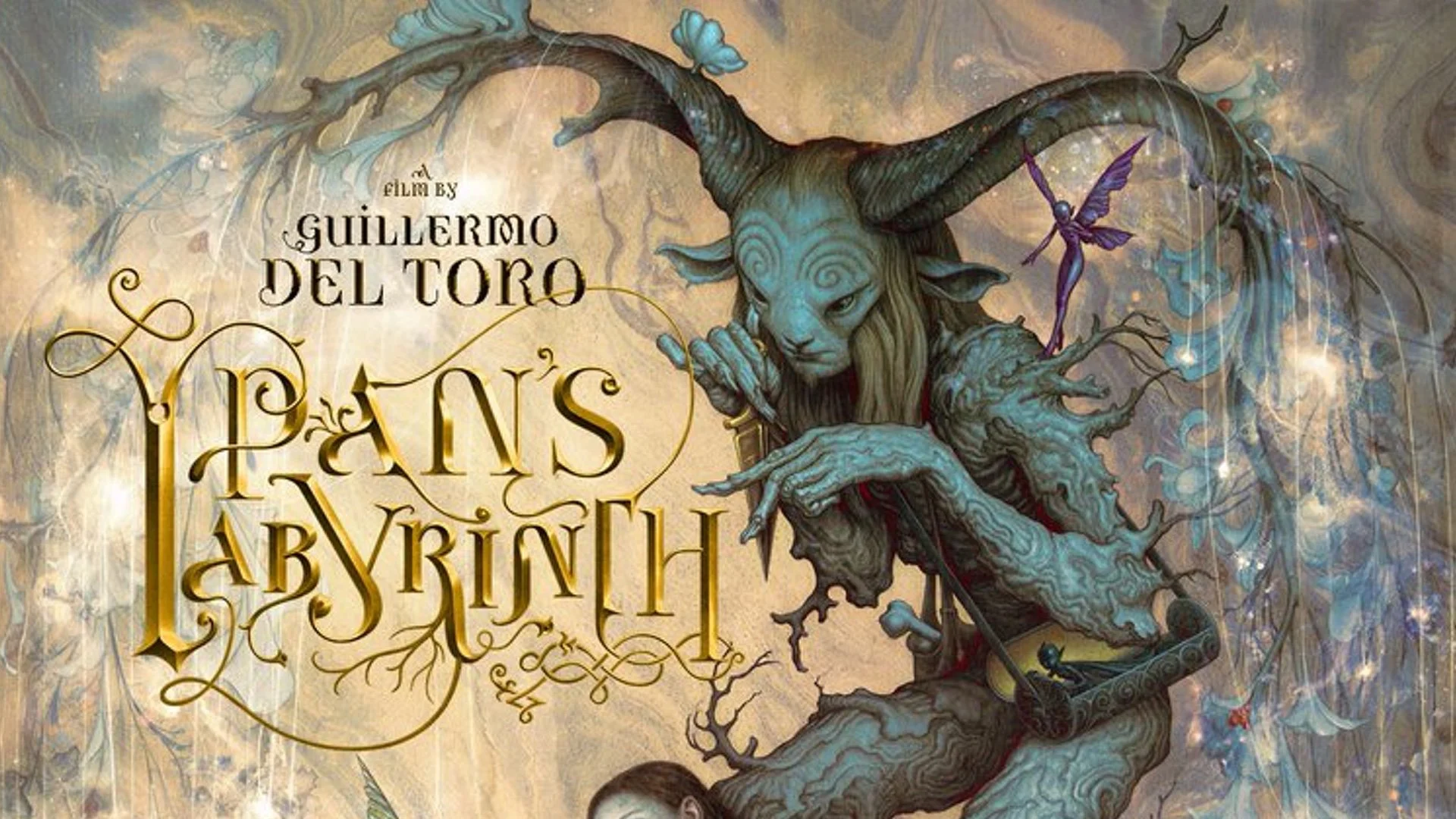
This week Pan’s Labyrinth is being re-released in cinemas to celebrate its 20th anniversary. Twenty years after its original release, Pan’s Labyrinth remains one of the most extraordinary fantasy films of the twenty-first century. Written and directed by Guillermo del Toro, the Spanish-language film combines the brutality of twentieth-century European history with the mysterious creatures, dangerous quests, and moral challenges of ancient mythology. It is simultaneously a historical drama, a dark fairy tale, a horror film, and a meditation on innocence, sacrifice, disobedience, and freedom.
Released in 2006, the film takes place in Spain in 1944, several years after the Spanish Civil War. Young Ofelia travels with her pregnant mother, Carmen, to a rural military outpost commanded by Captain Vidal, Carmen’s new husband. Vidal is a ruthless officer determined to destroy the resistance fighters hiding in the surrounding countryside. His obsession with discipline, obedience, and authority transforms the household into a place of fear.
Near the military outpost, Ofelia discovers an ancient stone labyrinth. There she encounters a mysterious faun who claims that she may be the reincarnation of a princess from a subterranean kingdom. To return to her original home, she must complete three dangerous tasks.
The film alternates between Vidal’s violent campaign and Ofelia’s encounters with the supernatural. Although these worlds appear separate, they reflect the same fundamental conflict: the difference between unquestioning obedience and the freedom to make moral choices.
The film’s artistic achievements were widely recognized. At the 79th Academy Awards in 2007, it received six nominations and won three Oscars, for Best Cinematography, Best Art Direction, and Best Makeup. Its extraordinary visual design, practical effects, and unsettling creatures helped establish it as a modern fantasy classic.
The twentieth anniversary in 2026 provides an opportunity to revisit the film’s lasting significance. Beyond its technical accomplishments, Pan’s Labyrinth draws on ancient myths and European folklore to explore questions about tyranny, identity, death, and the courage required to remain humane in a violent world.
The Labyrinth: From the Minotaur to Ofelia’s Journey
The most obvious connection between Pan’s Labyrinth and Greek mythology is the labyrinth itself. In ancient Greek tradition, the labyrinth is most famously associated with King Minos of Crete, the inventor Daedalus, and the monstrous Minotaur.
According to the myth, the Minotaur was born from the union of Pasiphaë, the wife of Minos, and a magnificent bull sent by Poseidon. The creature possessed the body of a man and the head of a bull. Minos ordered Daedalus to construct an elaborate labyrinth in which the Minotaur could be imprisoned. Its twisting passages made escape almost impossible, and Athens was eventually forced to send young people as tribute to the monster.
The hero Theseus volunteered to enter the labyrinth and kill the Minotaur. With help from Ariadne, Minos’s daughter, he used a thread to find his way back after defeating the creature.
The labyrinth became a powerful symbol of confinement, danger, disorientation, and the struggle to confront something monstrous. Del Toro transforms this symbol in his film. Ofelia’s labyrinth is not simply a prison for a monster but a threshold between the ordinary world and a mysterious realm in which she must discover her identity.
The two stories share a fundamental structure. A protagonist enters a confusing environment, faces trials, and must find a way through a space that tests more than physical courage. The labyrinth becomes an external representation of an internal journey.
There is an important difference between Theseus and Ofelia. Theseus enters the labyrinth to destroy a monster and escape alive. Ofelia enters it to discover whether she can reclaim a lost identity. Her journey is less about defeating one enemy than about making difficult choices.
The political setting adds another dimension. Vidal’s military headquarters is itself a kind of labyrinth, a place of surveillance, coercion, and restricted movement. Ofelia lives in a world where powerful men determine what she may do, say, and believe. The stone labyrinth offers an alternative path, but it does not provide a simple escape from responsibility.
Del Toro thus transforms an ancient symbol into a commentary on modern history. The monster need not always be a supernatural beast. Sometimes the real monster is a political system that treats human beings as expendable.
The Faun: Pan, Satyrs, and the Dangerous Spirits of Nature
The mysterious creature who guides Ofelia is the film’s most direct connection to classical mythology, although his identity is more complicated than the English title suggests. The original Spanish title, El laberinto del fauno, translates as The Labyrinth of the Faun. The English title refers to Pan, the Greek god associated with wild nature, shepherds, flocks, and rustic music. However, del Toro has explained that the character is a faun rather than Pan himself.
Pan was traditionally depicted with the legs and horns of a goat and the upper body of a man. He belonged to the wild landscapes beyond the ordered city, where civilized rules could not always be relied upon. Although Pan could be playful and protective, he could also inspire overwhelming fear. His name became associated with the word panic.
Satyrs were another group of rustic male beings in Greek mythology. Often depicted with animal features, they were associated with Dionysus, wine, celebration, and uncontrolled appetites. Their Roman counterparts and related woodland figures included fauns, associated with forests, fertility, and the unpredictable power of nature.
The faun in del Toro’s film draws on this broader mythological tradition. He appears ancient and physically unsettling, with twisted limbs and a body that seems to have grown out of the forest. His appearance blurs the boundaries between animal, tree, human, and supernatural being.
More importantly, the faun is morally ambiguous. He does not immediately inspire trust, and his intentions remain difficult to understand. He may be helping Ofelia fulfil her destiny, but he also places her in dangerous situations and expects her to follow difficult instructions.
This ambiguity distinguishes him from the familiar fantasy mentor who simply guides a hero toward the truth. Ofelia must learn that supernatural authority does not automatically deserve obedience.
The idea has deep roots in Greek mythology. The gods and spirits of ancient stories were rarely perfect moral examples. They could be generous, vindictive, seductive, violent, or indifferent to human suffering. An encounter with a supernatural being could bring a blessing, a curse, or both.
Ofelia’s relationship with the faun reflects this uncertainty. He may possess knowledge that she lacks, but she remains responsible for her decisions. The character is therefore not simply a cinematic version of Pan. He combines classical nature spirits with the mysterious guides and tricksters of European folklore.
Ofelia and Persephone: The Girl Who Belongs to Another World
One of the most compelling mythological parallels in Pan’s Labyrinth is the story of Persephone, the Greek goddess whose abduction by Hades connects the worlds of the living and the dead.
In the Homeric Hymn to Demeter, Persephone is gathering flowers when the earth opens and Hades carries her into the underworld. Her mother, Demeter, goddess of agriculture and fertility, searches desperately for her. During Persephone’s absence, Demeter’s grief causes the earth to become barren. Eventually, a compromise is reached: Persephone will spend part of the year with Hades and part with her mother. Her return becomes associated with the renewal of vegetation and the changing seasons.
Persephone’s myth is not identical to Ofelia’s story, but the two heroines share a powerful narrative pattern. Both are young female figures whose lives are divided between two worlds. Both must navigate a reality in which adults and supernatural powers make decisions that profoundly affect them. Both become associated with a hidden realm offering an alternative to the suffering of ordinary life.
The underworld in Greek mythology was not simply a place of punishment. It was the destination of the dead and the domain of Hades, but ancient traditions also imagined it as a place of mystery and transformation. The Eleusinian Mysteries, which centred on Demeter and Persephone, connected the goddesses’ story to sacred rites and hopes surrounding death and the afterlife.
Ofelia’s possible return to a subterranean kingdom evokes this tradition. She is presented as a princess who has lost her memory of her original home. Her tasks gradually establish whether she can return.
Yet del Toro complicates the traditional myth by placing Ofelia in a household dominated by a violent stepfather. She is already living in a world where she has little control over her future. The fantasy kingdom therefore represents more than an escape from human suffering: it offers the possibility that Ofelia possesses an identity and dignity that Vidal cannot define or erase.
There is an important difference between the stories. Persephone’s myth explains a cosmic cycle, connecting her disappearance and return to the fertility of the earth. Ofelia’s story is more personal and ethical. Its central question is whether she can preserve her moral identity in a world that demands obedience.
The resemblance should not be mistaken for proof that the film directly retells the Persephone myth. Rather, the two stories share themes that have made underworld journeys powerful across cultures: separation, transformation, loss, and the possibility of returning from an encounter with death changed forever.
The Forbidden Feast: The Pale Man and the Myth of Persephone
Perhaps the film’s most disturbing sequence occurs when Ofelia enters a mysterious chamber containing a lavish banquet. A terrifying creature known as the Pale Man sits at the table. The faun has warned Ofelia not to eat anything, but she consumes two grapes, awakening the monster and triggering a deadly pursuit.
This scene offers an intriguing comparison with the story of Persephone. In one of the best-known versions of her myth, Persephone eats pomegranate seeds while in the underworld. Because eating the food of the dead establishes a bond with that realm, she cannot simply return permanently to the world above.
The parallel with Ofelia is striking. In both stories, eating is not merely a physical act. It establishes a connection with the supernatural and changes the protagonist’s relationship with the world she has entered.
There is, however, an important distinction. Persephone’s pomegranate seeds help explain her eventual division between the underworld and the world of the living. Ofelia’s grapes do not establish an identical rule, and the film does not confirm that its scene is a direct adaptation of the Persephone episode. The connection is best understood as a mythological resonance.
The forbidden feast also recalls European fairy tales in which eating or drinking in the realm of spirits makes it difficult or impossible to leave. Del Toro combines this folkloric motif with a distinctly horrifying monster.
The Pale Man is not a figure from Greek mythology. Del Toro developed the creature for the film, drawing on visual and thematic ideas that include Francisco Goya’s painting Saturn Devouring His Son. The monster’s eyes are set into the palms of its hands, transforming the act of seeing into something grotesque. It must raise its hands to see, while its enormous dining table suggests a feast transformed into a scene of predation.
Nevertheless, the creature fits within the ancient mythological imagination. Greek mythology contains many beings who consume human flesh or turn hospitality into a trap. The Cyclops Polyphemus, for example, welcomes Odysseus and his men into his cave only to eat some of them. His cave becomes a prison, and Odysseus must rely on intelligence rather than strength to escape.
Both Polyphemus and the Pale Man embody a terrifying reversal of hospitality. A place that should offer nourishment becomes a place where visitors themselves are treated as food.
The banquet also carries a political meaning. Vidal’s world is characterized by hunger, inequality, and ruthless power, while the Pale Man’s chamber displays an abundance of food guarded by a creature that consumes the vulnerable. The scene invites a comparison between supernatural monstrosity and human systems in which the powerful enjoy their privileges while others suffer.
The Underworld, Hades, and the Possibility of Rebirth
The subterranean kingdom that appears at the end of Pan’s Labyrinth invites comparison with Hades, the realm of the dead in Greek mythology.
In Greek tradition, Hades was both the god who ruled the dead and the name commonly given to his domain. The underworld was not necessarily a place of eternal torment. Its inhabitants included ordinary souls, while certain exceptional figures experienced punishment or enjoyed a blessed existence. The realm was governed by its own laws, and the boundary between life and death was not something mortals could cross without consequence.
Several Greek heroes entered the underworld while still alive. Heracles descended as part of his labours, Orpheus attempted to retrieve Eurydice, and Odysseus visited the realm of the dead to consult the prophet Tiresias. Each journey involved crossing a boundary that ordinary humans could not easily cross.
Ofelia’s descent into a hidden kingdom belongs to this broader tradition of katabasis, the journey downward into the underworld. In mythology, a physical descent often becomes a spiritual or psychological transformation.
The story of Orpheus provides a particularly useful comparison. Orpheus travels into Hades to recover his beloved Eurydice. His music moves the powers of the underworld, and he is permitted to lead her back to the living world on the condition that he must not look behind him before they complete their ascent. He looks back too soon, and Eurydice is lost.
Orpheus’s journey explores love, hope, the limitations of human power, and the consequences of a decision. Ofelia’s journey similarly culminates in a test that cannot be completed through strength alone. Her final decision determines whether she has remained faithful to the values she has learned to defend.
There is a fundamental difference between the narratives. Orpheus attempts to reverse a death and restore an existing relationship. Ofelia’s story asks whether a young person can preserve moral freedom in a world dominated by violence. Her journey is not simply an attempt to defeat death, but a confrontation with the meaning of sacrifice.
The film leaves room for two interpretations of its supernatural events. The underground kingdom may be real within the story, or it may represent the world Ofelia constructs to survive unbearable circumstances. Del Toro allows the historical and fantastic dimensions to coexist without resolving every ambiguity.
If the kingdom is real, Ofelia’s suffering leads to a genuine return to her rightful home. If it is a fantasy, her imagination provides a language through which she can understand and resist a brutal world. In either interpretation, mythology gives her experience a meaning that the political authorities around her cannot control.
Three Tasks and the Structure of the Classical Hero’s Journey
The faun assigns Ofelia three tasks, giving the film the structure of a traditional quest narrative. This pattern appears throughout mythology, folklore, and epic literature. Heroes are often required to complete a series of trials before obtaining knowledge, rescuing someone, claiming an inheritance, or returning home.
The labours of Heracles provide one of the clearest examples. In Greek mythology, Heracles must complete a series of extraordinarily difficult tasks, including killing the Nemean Lion, capturing the Cretan Bull, and obtaining the golden apples of the Hesperides. His labours test his strength, endurance, ingenuity, and ability to overcome apparently impossible obstacles.
Jason’s quest for the Golden Fleece follows a related pattern. He assembles a group of heroes, travels to a distant kingdom, and confronts dangerous challenges before obtaining the object he seeks.
Ofelia’s tasks belong to the same broad storytelling tradition, but del Toro changes what the trials mean. They are not primarily demonstrations of physical strength. Instead, they test her judgement, courage, willingness to act independently, and ability to recognize when an instruction must be questioned.
The first task, involving a monstrous toad living beneath an ancient tree, draws on fairy-tale imagery and the mythological motif of confronting a creature that threatens the natural order. The tree is sick, and the creature feeding upon it must be removed before its condition can improve.
The second task, involving the Pale Man, tests Ofelia’s capacity to follow instructions and resist temptation. Here the film’s mythological and folkloric connections become particularly clear. The forbidden food resembles the dangerous consumption of otherworldly food, while the monster’s chamber recalls stories of heroes escaping creatures that turn hospitality into a trap.
The final task is the most important because it challenges the meaning of obedience itself. Ofelia must decide whether completing her quest justifies sacrificing someone else. Her decision reveals the moral principle at the heart of the film: not every command deserves to be obeyed.
This is where Ofelia differs from many traditional heroes. Her achievement is not simply that she completes her trials. It is that she discovers when the rules governing her quest conflict with her own conscience.
The comparison with Heracles is illuminating. Both characters face dangerous trials, but Heracles is remembered for extraordinary feats of strength and endurance, whereas Ofelia’s defining act is a refusal to commit an injustice. Her victory depends on recognizing that moral responsibility cannot be delegated to a powerful authority.
Captain Vidal: A Modern Monster in the Tradition of Greek Tragedy
The supernatural creatures of Pan’s Labyrinth are terrifying, but Captain Vidal is arguably its most frightening character. He represents the brutality of Francoist Spain and embodies a rigid belief in hierarchy, discipline, masculinity, and inherited authority.
Vidal’s obsession with his watch and his father’s legacy reveals his desire to control how he will be remembered. He wants his son to inherit a carefully constructed identity, and he views people primarily in terms of whether they serve or obstruct his ambitions.
This obsession has interesting parallels with the tyrants and kings of Greek tragedy. Classical drama repeatedly examines what happens when rulers mistake political authority for moral legitimacy.
Creon in Sophocles’ Antigone, for example, insists that his decree must be obeyed even when it conflicts with religious obligations and familial duty. Antigone refuses to accept his prohibition against burying her brother because she believes divine law and moral responsibility take precedence over the king’s command. Creon’s rigidity leads to catastrophe.
Ofelia’s conflict with Vidal echoes this tragic pattern. Both stories ask whether an individual should obey an authority that demands something fundamentally wrong. In Antigone, the conflict concerns burial rites, divine law, and the limits of political power. In Pan’s Labyrinth, it concerns the survival of innocence and the refusal to surrender another person’s life merely to satisfy an imposed rule.
Vidal is not a direct adaptation of Creon, and his character belongs primarily to the historical circumstances of the film. Nevertheless, the comparison reveals how ancient tragedy can illuminate modern political violence.
Greek tragedy often portrays a ruler’s downfall as the consequence of excessive pride, or hubris. The concept involves more than arrogance; it can describe an abuse of power that violates the proper limits of human conduct. Vidal’s insistence that the world must submit to his will resembles this tragic overreach.
His military power is real, but it cannot grant him moral authority. He can command soldiers, punish dissenters, and threaten his family, yet he cannot determine what is right simply by issuing an order.
The film’s political message is powerful because Vidal does not need supernatural abilities to become monstrous. His cruelty emerges from recognizable human institutions, prejudices, and ambitions.
The Mythological Importance of Sacrifice
Sacrifice is one of the central themes of Pan’s Labyrinth, and it has deep roots in Greek mythology. Ancient stories frequently place heroes in situations where achieving a desired outcome requires surrendering something valuable. Sometimes the sacrifice is voluntary; sometimes it is imposed by a god, ruler, or fate.
The story of Iphigenia is an especially relevant example. In the myth, Agamemnon’s fleet cannot sail to Troy because Artemis has become angered. In some versions, the king must sacrifice his daughter Iphigenia to secure favourable winds. The story raises disturbing questions about family loyalty, religious duty, military ambition, and the treatment of the innocent.
The circumstances differ greatly from Ofelia’s story, but both narratives examine whether the demands of a greater cause can justify the suffering of an innocent person.
In Pan’s Labyrinth, Vidal’s ambitions repeatedly place his family and the surrounding community in danger. His desire to preserve his name and legacy contrasts with Ofelia’s willingness to reject a demand that would violate her conscience.
Vidal believes sacrifice is justified when it serves his authority and future. Ofelia’s moral development leads her toward the opposite conclusion: a supposed destiny cannot excuse the deliberate harm of someone vulnerable.
The film also recalls the myth of Alcestis, who agrees to die in place of her husband, Admetus. Her willingness to sacrifice herself becomes an extraordinary expression of devotion, and Heracles eventually intervenes to restore her to life in the familiar version of the tale.
Ofelia’s sacrifice is not a direct retelling of Alcestis, but the comparison helps explain why the ending carries such emotional weight. Sacrifice becomes meaningful not because suffering is automatically noble, but because the decision reveals what the individual values most.
Del Toro also resists the simplistic message that goodness always produces material rewards. The historical world remains violent, and innocent people suffer. The possibility of a supernatural reward does not erase those losses.
Instead, the film asks whether moral integrity has value even when the world does not reward it. That question is as relevant to Greek tragedy as it is to the history of twentieth-century Spain.
Greek Mythology, Christian Symbolism, and European Folklore
One reason Pan’s Labyrinth feels so distinctive is that its mythological influences are not limited to Greece and Rome. Del Toro combines classical motifs with Spanish folklore, Christian symbolism, Gothic horror, and European fairy tales.
The faun belongs to the classical tradition of woodland spirits, but the film’s fairies, enchanted tree, underground kingdom, and magical tasks also draw on folklore. The rule against eating food in the otherworld, for instance, appears in fairy traditions far beyond classical mythology.
The film’s Christian imagery is particularly important in the Pale Man sequence. The creature’s eyes in its hands and the blood-stained appearance of the chamber evoke religious iconography, while the banquet suggests a grotesque reversal of sacred hospitality. The monster also connects to broader questions of institutional power and the consumption of children.
This does not make the Pale Man a Greek mythological figure. Rather, it shows how the film uses different traditions to construct a shared symbolic language. Classical mythology supplies the labyrinth, the underworld journey, and the ambiguous nature spirit. Folklore provides the dangerous food and the sequence of trials. Religious imagery helps express the corruption of authority and the vulnerability of the innocent.
These traditions share recurring concerns. They ask what lies beyond the visible world, what happens when people encounter powers they cannot control, and how individuals should behave when the rules of their society conflict with their deepest convictions.
The film’s creatures feel ancient because they are built from motifs that have circulated through storytelling for centuries. Yet their meanings remain relevant because del Toro connects them to recognizable human experiences: fear, grief, oppression, temptation, and hope.
Why Pan’s Labyrinth Still Matters After Twenty Years
Twenty years after its release, Pan’s Labyrinth remains a remarkable example of how mythology can be transformed into a modern cinematic language. Its anniversary offers an opportunity to appreciate not only its visual artistry but also the depth of its storytelling.
The film does not retell a single Greek myth. Instead, it draws upon a network of classical themes and motifs. Its labyrinth recalls Theseus and the Minotaur. Its faun evokes Pan, the satyrs, and the ambiguous spirits of the natural world. Ofelia’s relationship with a hidden kingdom recalls Persephone’s connection to the underworld, while the forbidden feast suggests the dangers of consuming food in a supernatural realm. Her descent and trials belong to a tradition of journeys that includes Orpheus, Odysseus, and Heracles.
The film’s greatest achievement is the way it adapts these ancient patterns to a story about political violence and moral freedom. Vidal’s brutality demonstrates that monsters do not always need horns, claws, or supernatural powers. Sometimes they wear uniforms, issue commands, and justify their actions through appeals to authority and tradition.
Ofelia offers a different understanding of heroism. She is not defined by physical strength or the ability to dominate others. Her courage lies in her willingness to question authority and accept the consequences of choosing what she believes to be right.
That moral conflict links the film to Greek tragedy, where human law, divine obligation, family loyalty, and justice are repeatedly tested. It also connects the film to myths of sacrifice and underworld journeys, in which a protagonist must confront suffering and emerge with a transformed understanding of the world.
Ultimately, Pan’s Labyrinth suggests that fantasy is not necessarily an escape from reality. It can be a way of confronting reality more honestly. Mythological creatures and magical kingdoms allow the film to express fears and hopes that historical drama alone might struggle to capture.
This is why the story continues to resonate after two decades. Like the ancient myths that inspired parts of its imaginative world, it invites audiences to question the limits of power, the meaning of sacrifice, and the courage required to remain humane in an inhumane world.
The labyrinth may be dark, the path uncertain, and the monsters terrifying. But the journey still matters because the choices made along the way reveal who we are. For more visit the official website of the movie.
Discover more from Hellenic Moon
Subscribe to get the latest posts sent to your email.