Mestra by Madeline Miller: Greek Mythology, Transformation and Survival
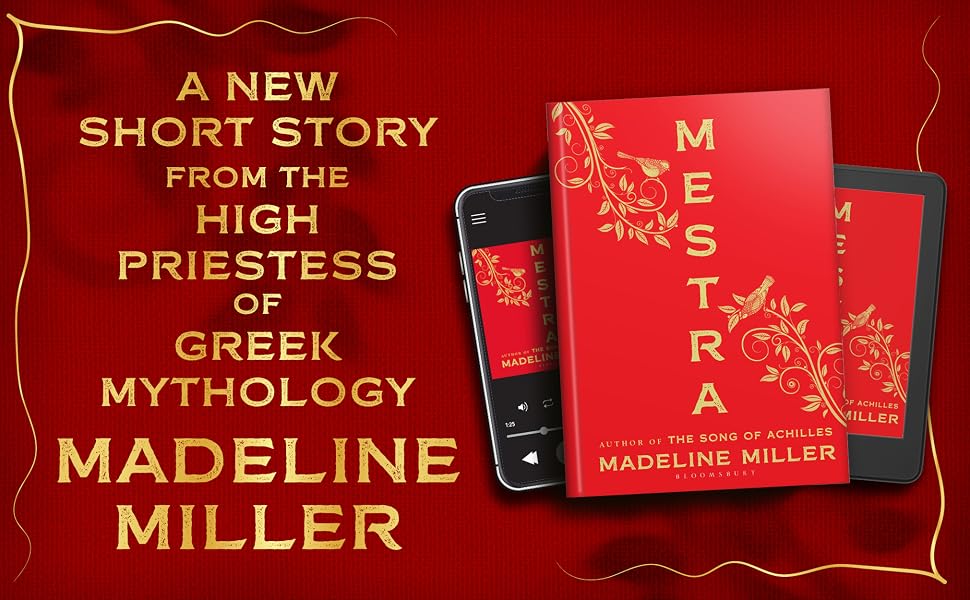
Madeline Miller has become one of the best-known modern writers of Greek mythology, particularly for her ability to bring the lives of mythological women to the forefront. The Song of Achilles retold the story of Achilles and Patroclus from an intimate perspective, while Circe transformed a relatively secondary figure from Homer’s Odyssey into a complex protagonist in her own right. Mestra continues this interest in the women who exist at the edges of the traditional Greek myths, focusing on a character whose ancient story is much less familiar to modern readers.
Mestra is the daughter of Erysichthon, a king whose terrible punishment comes after he commits an act of sacrilege against Demeter. Mestra herself possesses the extraordinary ability to transform her appearance, a power associated with the god Poseidon. In the ancient myth, her ability becomes a means of survival when her father’s insatiable hunger leads him to sell his own daughter repeatedly.
Although the surviving mythology surrounding Mestra is relatively brief, it contains many of the subjects that make Greek mythology so enduring: divine punishment, human arrogance, hunger, family, slavery, female agency, transformation and the conflict between humanity and nature. A modern retelling allows these themes to be expanded and examined through Mestra’s perspective.
The Forgotten Myth of Mestra
Mestra is one of the many fascinating women in Greek mythology who have been overshadowed by more famous figures such as Helen, Medea, Penelope, Circe and Ariadne. Her story survives primarily through ancient literary traditions concerning her father, Erysichthon, and the punishment inflicted upon him by Demeter.
Erysichthon was a wealthy and powerful man, but he was also arrogant. In the most important version of his story, he orders his men to cut down a sacred grove belonging to Demeter. When his servants hesitate because they recognise that the grove is sacred, Erysichthon takes the axe himself and begins destroying the trees.
His actions represent hybris, one of the central concepts in Greek mythology. Hybris describes excessive pride or arrogance, particularly when a mortal refuses to recognise the limits of human power. Greek mythology repeatedly warns that human beings who challenge the gods or believe themselves above divine laws eventually suffer disastrous consequences.
Demeter’s response is particularly appropriate because she is the goddess of agriculture, fertility and the crops upon which human survival depends. She punishes Erysichthon by giving him an insatiable hunger. No matter how much food he consumes, he remains desperately hungry.
This curse eventually destroys his wealth. He sells possessions, animals and eventually his daughter Mestra in an attempt to obtain enough money to satisfy his appetite.
Erysichthon and the Curse of Hunger
The punishment of Erysichthon is one of the strangest and most memorable forms of divine punishment in Greek mythology. Rather than killing him immediately, Demeter creates a condition that makes ordinary life impossible.
Hunger is normally a natural and necessary part of human existence. People eat because they need nourishment, and food sustains civilisation. Erysichthon’s hunger, however, has become unnatural. Eating provides no satisfaction, meaning that he is trapped in an endless cycle of consumption.
This gives the myth a powerful symbolic dimension. Erysichthon destroys the sacred grove because he wants to use the natural world for his own purposes. His punishment is to become a creature that can never stop consuming.
The connection between his crime and his punishment is therefore deliberate. He takes from nature without respect or restraint, and his own appetite becomes equally destructive.
The story can also be connected to the broader Greek understanding of hubris and nemesis. Mortals are expected to understand their limitations. When they go beyond those limits, divine forces restore the balance.
Erysichthon’s tragedy is therefore not simply that he becomes hungry. His punishment gradually destroys everything that once made him powerful. His wealth cannot save him, and eventually even his family becomes something he is willing to sacrifice.
Demeter and the Sacred Grove
Demeter’s role is essential to understanding the mythology behind Mestra. She is much more than simply the goddess who curses Erysichthon.
Demeter represents agriculture, fertility and the cycle through which the earth provides food for humanity. Her importance is especially clear in the famous myth of Persephone, in which the disappearance of her daughter causes the earth to become barren.
The stories of Persephone and Erysichthon therefore share an important theme: Demeter controls the availability of food and fertility. In one story, famine results from a mother’s grief; in the other, it becomes a punishment for human arrogance.
The sacred grove is significant because ancient Greeks did not necessarily view nature as something entirely separate from religion. Particular trees, springs, mountains and forests could be associated with gods and nymphs. Destroying such a place could therefore constitute a direct attack upon the divine order.
Erysichthon’s crime is consequently both environmental and religious. He treats a sacred part of nature as though it exists solely for his personal benefit.
That makes the story surprisingly relevant to modern audiences. The ancient myth suggests that unlimited exploitation of nature ultimately carries consequences. Erysichthon believes that he can take whatever he wants, but his punishment turns his own desire into an unstoppable force.
Mestra’s Extraordinary Power
Mestra’s most distinctive characteristic is her ability to transform herself.
Transformation is extremely common in Greek mythology. Gods frequently disguise themselves or change their appearance, while mortals are sometimes transformed by divine intervention. Daphne becomes a laurel tree while escaping Apollo, Io is transformed into a cow, and Callisto becomes a bear.
Mestra is different because transformation is not simply something that happens to her. It is a power she can use.
According to the ancient tradition, Poseidon gives Mestra the ability to change her form. This gift becomes enormously important because her father repeatedly sells her in order to obtain money to buy food.
Mestra can escape her purchasers by transforming herself and returning to her father. Erysichthon can then sell her again.
The story is disturbing because Mestra’s body becomes part of her father’s economy of survival. Yet her supernatural ability gives her a way of resisting permanent possession.
This makes transformation a particularly meaningful symbol in a modern interpretation. Mestra can literally change the identity that other people attempt to impose upon her.
Poseidon and the Gift of Transformation
Poseidon is one of the most important gods in Greek mythology and one of the three great brothers who divide the cosmos after the overthrow of Cronus. Zeus receives the heavens, Hades the Underworld, and Poseidon the sea.
Poseidon is also associated with earthquakes and horses and is frequently depicted as a powerful, unpredictable deity. Like Zeus, he has numerous relationships with both divine and mortal women.
His connection with Mestra is particularly interesting because he is responsible for the supernatural ability that distinguishes her from other mortals.
In mythology, gifts from the gods are rarely simple. Divine intervention can provide protection or power, but it can also create new complications. Mestra’s transformation ability, however, ultimately becomes an instrument through which she can survive the circumstances created by her father’s curse.
The contrast between Poseidon’s enormous divine power and Mestra’s ability to change form also reinforces an important characteristic of Greek mythology: mortals can sometimes possess extraordinary abilities without ever becoming gods themselves.
Mestra and the Power of Transformation
Transformation has a particularly strong connection with questions of identity in Greek mythology.
Many famous transformations happen against the will of the person being transformed. Daphne’s transformation into a tree allows her to escape Apollo, but it also ends her existence as a human being. Io’s transformation into a cow becomes part of her suffering. Other mythological transformations are punishments or consequences imposed by gods.
Mestra’s situation is much more empowering. She can transform deliberately.
This gives her a form of agency that is unusual among mythological women. If another person attempts to control her, she possesses the ability to change. If she is given an identity by someone else, she can abandon it.
Her power therefore has a symbolic meaning beyond its supernatural origins. Mestra represents adaptability. She survives not by defeating the forces around her physically but by refusing to remain fixed within the identity they have assigned to her.
The Tragedy of Erysichthon’s Family
One of the darkest elements of the story is Erysichthon’s willingness to sell his own daughter.
His curse has progressed beyond ordinary hunger. His appetite has destroyed the normal bonds between human beings. His daughter becomes a resource rather than a person.
This demonstrates the destructive nature of his punishment. Demeter does not merely make Erysichthon suffer physically; his curse causes him to destroy his own social and family relationships.
Mestra, meanwhile, is placed in an impossible position. She must survive the consequences of a crime she did not commit.
This is another important feature of Greek mythology. Characters are frequently affected by the actions of their parents. Family curses, inherited guilt and ancestral conflicts appear throughout Greek literature.
Mestra therefore belongs to the same broad tradition as figures such as Orestes, who inherits the consequences of his family’s violent history. The difference is that Mestra’s response is not revenge but adaptation.
Women, Agency and Survival
A modern retelling of Mestra naturally invites attention to the position of women in Greek mythology.
Many women in ancient myths are defined through their relationships with men. They are daughters, wives, mothers or lovers. Their lives are often shaped by decisions made by gods, kings and heroes.
Mestra’s transformation gives her an unusual opportunity to escape those definitions.
Her power is not primarily a weapon of physical destruction. Instead, it allows her to negotiate a world in which she has very little conventional power.
This places her within a wider tradition of intelligent and resourceful women in Greek mythology. Odysseus is famous for his metis, or cunning intelligence, and several mythological women survive through similar qualities. Ariadne uses her knowledge to help Theseus navigate the Labyrinth, while Medea relies upon intelligence and magical knowledge to achieve her objectives.
Mestra’s strength lies in adaptability. She demonstrates that survival does not always require physical power.
The Importance of Food in Greek Mythology
Food is one of the most important recurring symbols in Greek mythology, making Erysichthon’s hunger especially significant.
The gods themselves are associated with special forms of divine nourishment, while humans depend upon agriculture and the changing seasons. The myth of Persephone uses food as a symbol of the boundary between life and death. Persephone’s consumption of the pomegranate seeds connects her permanently to the Underworld.
In Erysichthon’s story, food takes on a darker meaning. He can consume everything but can never be satisfied.
This makes him almost the opposite of Persephone. Her eating establishes a permanent connection between two worlds, while his eating destroys his connection with the human world around him.
His hunger is also the direct consequence of violating Demeter, the goddess responsible for agriculture and nourishment. Food therefore becomes the mechanism through which Demeter exercises her power.
Nature, Arrogance and the Greek Moral Imagination
The destruction of Demeter’s grove gives Mestra an important environmental dimension.
Greek mythology often presents nature as something sacred rather than simply a collection of resources. Mountains, rivers, forests and springs can all have divine associations.
Erysichthon’s mistake is believing that his status as a powerful human being gives him unlimited authority over nature.
The story argues otherwise.
His destruction of the grove ultimately leads to his own destruction. The more he consumes, the less he has. His wealth disappears, his family is endangered and his existence becomes dominated by hunger.
The myth therefore creates a powerful cycle: Erysichthon attempts to control nature, and nature, through Demeter’s divine power, ultimately destroys his ability to control himself.
Why Mestra Matters Today
The enduring appeal of Mestra lies in the fact that the story can be read on several different levels.
It is a myth about divine punishment, but it is also a story about an individual surviving circumstances she did not create. It is about the destructive consequences of greed, but also about the power of adaptability.
Most importantly, it demonstrates how much potential remains in the lesser-known corners of Greek mythology.
Mestra is not an Olympian goddess or a famous epic hero. Her name is absent from many modern introductions to Greek mythology. Yet her story contains many of the same themes found in the most famous myths: the conflict between gods and mortals, the consequences of hybris, the power of fate, the importance of family and the struggle to maintain one’s identity.
Madeline Miller’s retelling gives this forgotten figure the opportunity to become more than a footnote.
Mestra by Madeline Miller
Mestra is rooted in one of the stranger stories of Greek mythology, but the myth becomes surprisingly rich when viewed through Mestra herself. Erysichthon’s destruction of Demeter’s sacred grove represents hybris and humanity’s attempt to exploit nature without limits. His resulting hunger becomes a punishment that consumes his wealth, his family and ultimately his own humanity.
Mestra provides the opposite image. While her father is trapped in an endless cycle of consumption, she survives through transformation. Her supernatural ability, granted through her connection with Poseidon, gives her the power to escape identities imposed upon her.
This makes her an especially compelling figure for a modern mythological retelling. She represents adaptability rather than brute strength, intelligence rather than conquest, and survival rather than heroic glory.
The mythology surrounding Mestra also demonstrates why Greek myths continue to inspire modern writers. These stories were never simply tales of gods and monsters. They explored human weaknesses and strengths: arrogance, desire, grief, love, hunger, intelligence and the struggle for freedom.
In bringing Mestra into the spotlight, Madeline Miller has the opportunity to do what she has done with other overlooked mythological women: take a character who once occupied the margins of a famous tradition and ask what happens when her story becomes the centre of the narrative.
Mestra’s ancient story may be small compared with the Iliad or the Odyssey, but its themes are enormous. It is a story about the dangers of limitless desire, the sacredness of nature, the consequences of arrogance and, above all, the remarkable ability of a person to change in order to survive. Go to the official website of Madeline Miller for more.
Discover more from Hellenic Moon
Subscribe to get the latest posts sent to your email.