Maserati: The Brothers — The History of an Italian Automotive Legend and Its Mythological Emblem
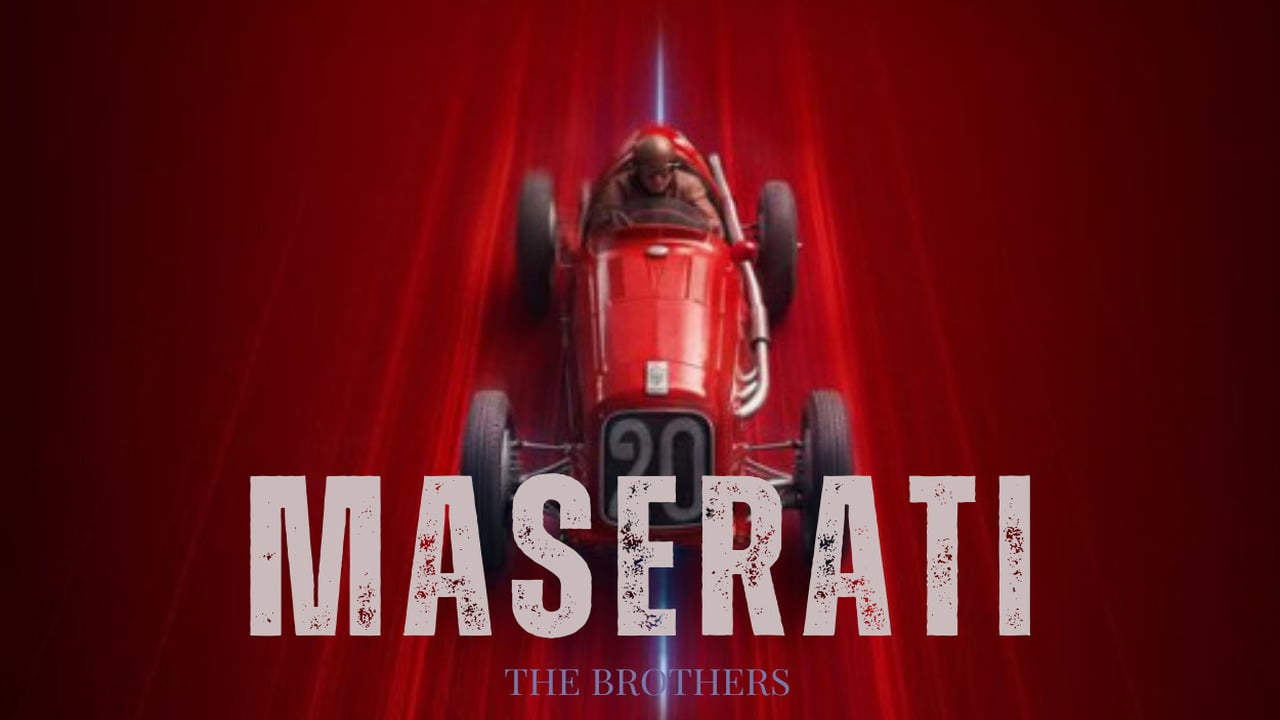
The newly-released film Maserati: The Brothers explores the family behind the famous automotive brand and the determination that helped transform a small Italian engineering business into an internationally recognized luxury car manufacturer. The story is particularly compelling because Maserati’s identity is inseparable from the personalities, ambitions, and sacrifices of the people who built it.
A Family, a Dream, and a Trident
The story of Maserati is one of the most fascinating chapters in Italian automotive history. It combines the ambition of a family of engineers, the excitement of motor racing, the elegance of Italian design, and a remarkable connection to classical mythology. For more than a century, Maserati has represented a distinctive vision of the automobile: a machine that should be as beautiful as it is powerful.
One of the brand’s most recognizable features, however, reaches far beyond the twentieth century. Its famous trident logo was inspired by the weapon carried by Neptune, the Roman god of the sea, whose Greek counterpart is Poseidon. The inspiration came from the celebrated Fountain of Neptune in Bologna, the Italian city where the Maserati brothers established their automotive enterprise.
This connection makes Maserati particularly interesting to enthusiasts of Greek mythology. Its emblem links ancient mythology, Renaissance sculpture, and modern automotive engineering in a way few other car manufacturers can match.
Understanding the film means exploring three interconnected stories: the Maserati family, the development of one of Italy’s most celebrated automobile manufacturers, and the journey of an ancient mythological symbol into the modern world of engineering and luxury.
The Film Maserati: The Brothers
Maserati: The Brothers is a biographical sports drama directed by Bobby Moresco, the Academy Award-winning screenwriter known for Crash (2004). Produced by Andrea Iervolino, the film tells the story of the Maserati family and its efforts to establish a name in the competitive world of motor racing.
The cast includes Michele Morrone as Alfieri Maserati, Salvatore Esposito as Bindo Maserati, and Lorenzo De Moor as Carlo Maserati. International actors including Anthony Hopkins, Al Pacino, Andy García, and Jessica Alba are also associated with the production.
The story takes place during the early twentieth century, when automobiles were transforming transport and motor racing was becoming a powerful demonstration of engineering ability. The Maserati brothers wanted to build machines capable of challenging established manufacturers and winning races that demanded speed, reliability, and technical precision.
The production recreates historical racing cars inspired by Maserati models from the 1920s and 1930s, bringing the company’s early history to the screen. Filming locations include cities associated with its development, particularly Bologna and Modena.
The historical story provides plenty of dramatic material: family relationships, financial uncertainty, competition, and personal loss. However, as with other biographical films, some events may be adapted for dramatic purposes.
The real history is remarkable in its own right. The Maserati brothers began with mechanical expertise and a shared passion for automobiles, eventually creating a brand that would become synonymous with Italian performance and luxury.
The Maserati Brothers: Seven Sons and a Passion for Engineering
The Maserati family consisted of seven sons born to Rodolfo Maserati and Carolina Losi. Rodolfo worked for the Italian state railway, and several of his sons developed an interest in mechanical engineering and automobiles.
Carlo Maserati was among the first to pursue automotive engineering and racing. Alfieri became the most prominent figure in the family’s automotive enterprise, establishing himself as both an engineer and a racing driver. Ettore and Ernesto contributed to the technical development of the business, while Bindo later joined the company.
Mario Maserati followed a different path. Rather than concentrating on engines and racing, he pursued artistic interests. His contribution would nevertheless become one of the family’s most enduring legacies: the design of the Maserati trident.
The brothers’ different abilities helped establish the company. Their combined knowledge of engineering, competition, and design allowed them to develop not only automobiles but also a recognisable identity.
Their story is therefore about more than mechanical innovation. It is about a family whose individual talents combined to create something that outlived its founders.
1914: The Foundation of Maserati in Bologna
Maserati was officially founded on 1 December 1914, when Alfieri Maserati and his brothers Ettore and Ernesto established a business in Bologna under the name Ditta Alfieri Maserati.
The original premises were located at Via de’ Pepoli 1A, in the historic centre of the city. Initially, the company operated as a mechanical and automotive workshop rather than as a large-scale automobile manufacturer.
The timing was significant. The automotive industry was developing rapidly, and motor racing was becoming an important way for manufacturers to demonstrate their technical capabilities. A successful racing car could attract customers and establish a reputation for speed and reliability.
The First World War disrupted industrial production and commercial activity, complicating the brothers’ ambitions. Nevertheless, their engineering experience provided the foundation for the company’s subsequent growth.
Maserati’s origins are important because its later reputation for luxury can obscure its early identity. The company emerged from a world of mechanical experimentation and competitive racing. Performance and engineering were central to its character long before it became famous for elegant grand touring cars.
Bologna also provided an important cultural connection. Its historic streets and monuments included celebrated works of classical-inspired art, one of which would give Maserati its distinctive emblem.
The Trident: How Neptune Inspired the Maserati Logo


The Maserati trident is much more than a decorative badge. It connects the company’s history with Bologna’s artistic heritage and the mythology of the ancient Mediterranean.
Its inspiration came from the Fountain of Neptune, known in Italian as the Fontana del Nettuno, located near Piazza Maggiore in central Bologna. The fountain features a monumental bronze statue of Neptune, the Roman god of the sea, holding his characteristic three-pronged weapon.
The sculpture was created by the Flemish-born artist Jean de Boulogne, better known as Giambologna, during the sixteenth century. It became one of Bologna’s most recognisable landmarks.
When Maserati was preparing to introduce its first racing car under the family name, the brothers needed an emblem that would distinguish their vehicles. Mario Maserati drew inspiration from Neptune’s trident and developed the design that became the company’s signature. The emblem appeared on the Maserati Tipo 26 in 1926.
The choice was remarkably effective. The trident’s distinctive shape remains recognisable even when reproduced as a small metal badge. Its associations with power and authority also suited a manufacturer seeking to establish itself in competitive motor racing.
The logo connected Maserati directly to its birthplace. Rather than adopting an unrelated animal or abstract design, the company chose a symbol inspired by a famous monument in Bologna.
The emblem consequently carries several layers of meaning. It recalls the city’s cultural identity, evokes classical mythology, and represents the company’s engineering and racing heritage.
Neptune and Poseidon: The Mythological Connection
Neptune is the Roman counterpart of the Greek god Poseidon. Both are associated with the sea, earthquakes, horses, and the trident, although their religious traditions developed within different cultural settings.
In Greek mythology, Poseidon is one of the principal Olympian gods. He is the son of Cronus and Rhea and the brother of Zeus and Hades. After the overthrow of the Titans, the brothers divide the cosmos, with Poseidon receiving dominion over the sea.
Poseidon’s trident is his defining attribute. In ancient stories, he uses it as an instrument of divine power, capable of stirring the waters, generating storms, and shaking the earth. His association with horses is also important, and some traditions credit him with creating the first horse.
Roman mythology inherited much of this symbolism through Neptune, who became increasingly identified with Poseidon as Greek mythology influenced Roman literature and art.
The Maserati logo does not illustrate a specific mythological episode. Instead, it isolates the god’s most recognisable attribute and transforms it into a compact corporate symbol.
This simplicity is one reason the design has endured. The trident is easy to recognise, reproduce, and associate with the mythology from which it originated.
Why the Trident Was Perfect for Maserati
The trident’s symbolism also suited the ambitions of the Maserati brothers. Neptune’s authority over the sea suggested strength and mastery, while the weapon’s symmetrical shape conveyed precision and balance.
These qualities could easily be associated with powerful engines, carefully engineered machines, and the determination required to succeed in motor racing.
The logo’s racing associations became particularly meaningful in 1926, when the Tipo 26 made its competitive debut. The trident was no longer simply a reference to Bologna’s cultural heritage; it became the emblem of a genuine racing machine.
The Maserati Tipo 26: The Trident Takes to the Track


The year 1926 marked a turning point for Maserati. The company introduced the Tipo 26, its first original racing car to carry the Maserati name and trident emblem.
The car featured a supercharged 1.5-litre, eight-cylinder engine and a lightweight chassis designed for competition. Its engineering demonstrated that the young manufacturer could compete against established rivals.
On 25 April 1926, Alfieri Maserati drove the Tipo 26 in the Targa Florio, one of Europe’s most challenging races. Held on demanding Sicilian roads, the competition required drivers to negotiate sharp corners, uneven surfaces, and significant changes in elevation.
Alfieri won his engine class and finished eighth overall, an impressive achievement for the new manufacturer.
The result established an early association between the trident and racing success. The emblem’s reputation grew through the performance of the vehicles carrying it, rather than through advertising alone.
Alfieri was central to this achievement. As both engineer and driver, he understood the practical demands of competition and could test the machines he helped develop. The Tipo 26 gave Maserati credibility and established the foundation for its subsequent racing achievements.
Tragedy and the Company’s Move to Modena
The early history of Maserati also involved personal tragedy. Alfieri Maserati died in 1932 following complications associated with earlier health problems. His death was a significant loss for a company closely associated with his engineering abilities and leadership.
The business continued under his brothers, with Bindo joining in 1932. However, maintaining the enterprise without its most prominent founder presented challenges.
In 1937, the Maserati brothers sold the company to industrialist Adolfo Orsi. The business subsequently moved its operations from Bologna to Modena, where it established its headquarters at Viale Ciro Menotti.
Modena would become one of the most important centres of Italian automotive engineering. Maserati became part of a regional tradition that included several celebrated sports-car manufacturers.
Although the brothers gradually stepped away from the company, their technical legacy remained. The trident preserved a connection to the original business and its beginnings in Bologna, even as ownership and management changed.
Maserati’s Racing Glory


Maserati’s achievements on the racetrack transformed it into an internationally respected name.
In 1939 and 1940, American driver Wilbur Shaw won the Indianapolis 500 driving the Maserati 8CTF, known as the Boyle Special. These consecutive victories demonstrated that Maserati’s engineering could succeed beyond Europe.
After the Second World War, the company became increasingly involved in grand prix racing. Its cars attracted talented drivers and developed a reputation for combining mechanical sophistication with speed.
The most celebrated achievement came in 1957, when Juan Manuel Fangio won the Formula 1 World Championship driving the Maserati 250F. Fangio was already considered one of the greatest drivers of his era, and the championship became a defining moment in Maserati’s history.
The 250F remains one of the most admired racing cars of its period, embodying the combination of engineering and elegance associated with Italian motorsport.
Maserati’s racing heritage continued in later decades. The MC12 achieved six FIA GT international championship titles between 2005 and 2010, while the Maserati GT2 has continued the company’s involvement in modern circuit racing.
These achievements continually renewed the meaning of the trident. What began as a reference to an ancient god became a symbol associated with genuine sporting success.
From Racing Cars to Italian Luxury


Although racing remains fundamental to Maserati’s identity, the company gradually became equally famous for its road cars.
After the Second World War, Italian automotive design gained an international reputation for combining engineering quality with elegance. Maserati became part of this movement, producing vehicles that offered performance alongside comfort and refinement.
Its grand touring cars were particularly important. Designed for high-speed road travel rather than racing alone, they combined sporting character with the comfort needed for long journeys.
Models such as the 3500 GT and the Ghibli helped establish this philosophy, demonstrating that Maserati could translate its racing heritage into sophisticated road cars.
The company experienced financial difficulties, changes in ownership, and strategic shifts over the decades. Nevertheless, the trident remained a constant visual link between its different eras.
Whether displayed on a historic racing car or a modern luxury coupe, the emblem signifies a tradition rooted in Italian engineering, distinctive design, and motorsport.
The Evolution of the Trident Logo
The Maserati emblem has evolved since its creation, but its central image has remained remarkably consistent.
The original badge appeared on the Tipo 26 in 1926. Later versions incorporated the familiar oval shape and red-and-blue colours associated with Bologna. Subsequent redesigns adjusted the proportions and presentation to suit changing design conventions.
The trident itself remained the defining feature.
This continuity demonstrates the strength of a successful brand symbol. A logo can change in detail while retaining the element that makes it recognisable.
In 2026, the trident celebrates its centenary as an automotive emblem. Its longevity reflects the ability of a symbol rooted in classical mythology to remain relevant across generations of vehicles, technological developments, and international markets.
Maserati: From the Fountain of Neptune to the Open Road
Maserati: The Brothers revisits the origins of one of Italy’s most distinctive automotive manufacturers. Its history begins with a family of mechanically minded brothers in Bologna and continues through racing victories, industrial expansion, and the development of a luxury-car brand.
Yet the trident may be the company’s most enduring legacy.
Designed by Mario Maserati and inspired by the Fountain of Neptune, the emblem connected the brothers’ ambitions to the cultural heritage of their city. Its appearance on the Tipo 26 in 1926 coincided with Maserati’s first major racing success, establishing a relationship between the symbol and competition that has lasted a century.
The story demonstrates how classical mythology continues to influence modern culture. Poseidon’s trident, an attribute of divine authority in Greek mythology, became Neptune’s weapon in Roman iconography, a feature of Bologna’s public art, and finally the badge of an internationally recognised automobile manufacturer.
The Maserati story is therefore about more than cars. It is a story of family, ambition, engineering, art, and cultural continuity.
The next time a Maserati drives past, its emblem can evoke Poseidon, Neptune, the celebrated sculpture in Bologna, and the brothers who transformed an ancient mythological symbol into a modern icon of Italian engineering. For more info, visit the official website of the company.
Discover more from Hellenic Moon
Subscribe to get the latest posts sent to your email.