Percy Jackson and the Olympians – Season 3 Now Streaming on Disney+
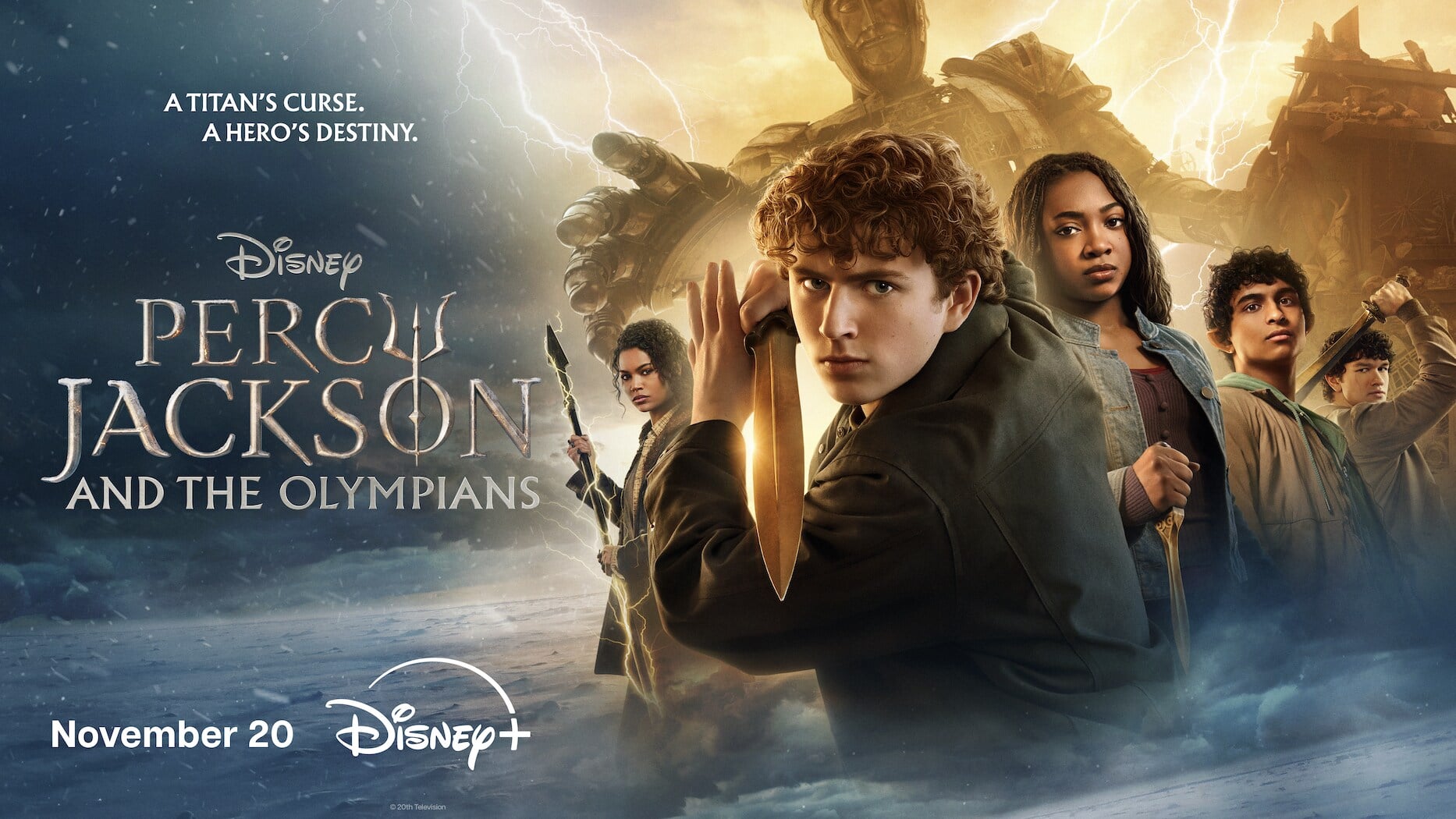
This week the third season of Percy Jackson and the Olympians came out on Disney+. The world of Greek mythology continues to inspire modern entertainment, and few recent television productions have embraced the subject as enthusiastically as Disney+’s Percy Jackson and the Olympians. Based on the bestselling novels by Rick Riordan, the series brings the gods, monsters, heroes and legendary creatures of ancient Greece into the modern world, combining classical mythology with contemporary adventure and coming-of-age storytelling.
Following Percy Jackson, a teenager who discovers that he is the son of Poseidon, the series explores a world in which the Olympian gods still exist, ancient prophecies remain important and mythological monsters continue to threaten humanity. One of its greatest strengths is its ability to make complicated ancient stories accessible to younger audiences while retaining the themes and characters that made Greek mythology so enduring.
The third season adapts The Titan’s Curse, the third novel in Rick Riordan’s original five-book series. It introduces several important figures from Greek mythology, including Artemis, Atlas and the ancient forces associated with Kronos. It also expands the series’ exploration of the complicated relationship between the Olympian gods and the Titans.
This article explores the mythology behind the third season without revealing its season-specific plot developments or major story twists.
The Titan’s Curse: The Literary Foundation of Season 3
Published in 2007, The Titan’s Curse represents an important transition in the Percy Jackson novels. While the earlier books introduce the world of demigods and establish the conflict between the Olympian gods and the ancient Titans, the third instalment expands this mythology considerably.
The title refers to one of the central conflicts of Greek mythology: the struggle between two generations of divine beings. This is not simply a battle between good and evil. It is also a story about family relationships, rebellion, inherited responsibilities and the consequences of ancient decisions.
The third season offers an opportunity to explore some of the most fascinating characters and stories from classical mythology, bringing together gods, Titans, legendary hunters and supernatural creatures.
The Titans and Kronos: The Ancient Enemies of Olympus
Before Zeus, Poseidon, Hades and the other Olympian gods established their authority, the universe was ruled by an older generation of divine beings known as the Titans. According to Hesiod’s Theogony, the Titans were children of Gaia, the Earth, and Uranus, the Sky. Among the most important were Kronos, Rhea, Oceanus, Hyperion, Themis and Iapetus.
Kronos became ruler of the Titans after overthrowing his father Uranus. However, a prophecy predicted that one of his own children would eventually overthrow him. Determined to prevent this, Kronos swallowed his children as soon as they were born. His wife, Rhea, eventually saved their youngest child, Zeus, by hiding him and giving Kronos a stone wrapped in clothing instead. Zeus survived, grew to adulthood and eventually challenged his father.
This conflict developed into the Titanomachy, the legendary war between the Titans and the younger Olympian gods. Zeus and his siblings eventually defeated the Titans, establishing a new divine order centred on Mount Olympus.
One of the most important figures in this mythology is Kronos himself. Although frequently associated with time in later interpretations, he should not be confused with Chronos, the primordial personification of time.
In Rick Riordan’s fictional universe, Kronos represents the ancient generation’s continuing challenge to the Olympian order. His presence connects Percy’s modern adventures with the earliest stories of Greek mythology.
The conflict also raises an interesting philosophical question: are the Olympians genuinely better rulers than the Titans, or have they simply inherited power from an older generation?
Artemis: Goddess of the Hunt and Wilderness
One of the most fascinating mythological figures associated with The Titan’s Curse is Artemis, the Greek goddess of hunting, wilderness and wild animals. Artemis was the daughter of Zeus and the Titaness Leto, and the twin sister of Apollo. While Apollo was associated with music, prophecy, healing and civilisation, Artemis represented the untamed natural world. She was traditionally depicted carrying a bow and arrows, often accompanied by a deer or hunting dogs. She was also associated with childbirth and the protection of young girls.
One of the most distinctive aspects of her mythology was her commitment to remaining unmarried. Artemis valued independence and demanded a similar commitment from her female companions. This distinguished her from many other Olympian goddesses, whose stories frequently revolved around marriage and romantic relationships.
Artemis was also famous for protecting her honour and punishing those who offended her. One example is the myth of Actaeon, a hunter who accidentally encountered the goddess while she was bathing. In some versions, Artemis transformed him into a stag, after which his own hunting dogs attacked him because they no longer recognised their master.
Another famous story involves Niobe, a queen who boasted that she was superior to Leto because she had more children. Artemis and Apollo punished her for insulting their mother, killing her children.
These stories demonstrate that Artemis was not simply a gentle protector of nature. She was a powerful goddess who demanded respect and could be extremely unforgiving.
The Hunters of Artemis
One of the most interesting elements of Riordan’s interpretation is the Hunters of Artemis.
Ancient Greek mythology frequently describes Artemis travelling with groups of nymphs who accompanied her through forests and mountains. Riordan develops this tradition into an organised group of immortal female hunters who follow the goddess and dedicate themselves to her service.
This modern reinterpretation allows the series to explore themes of sisterhood, loyalty, independence and personal identity. It also gives Artemis a distinctive role within the Percy Jackson universe, separating her from the more traditional authority exercised by Zeus and Poseidon.
Atlas and the Golden Apples of the Hesperides
Another important figure connected with The Titan’s Curse is Atlas, one of the most recognisable Titans in Greek mythology.
Following the defeat of the Titans, Zeus punished Atlas by forcing him to hold up the heavens. This became one of the most famous images in classical mythology, representing extraordinary strength, endurance and the burden of responsibility. Interestingly, Atlas was not originally condemned to carry the Earth. His punishment was to support the celestial heavens, preventing the sky from collapsing onto the Earth.
Atlas is also connected with the Twelve Labours of Heracles. During one of his most famous adventures, Heracles was ordered to obtain the golden apples of the Hesperides.
The Hesperides were nymphs who guarded a magnificent garden at the western edge of the world. The golden apples were associated with immortality and belonged to Hera, who had received them as a wedding gift. The garden was also protected by Ladon, a terrifying dragon with multiple heads in some accounts.
Heracles eventually encountered Atlas and asked for his help in obtaining the apples. Atlas agreed, but attempted to avoid returning to his punishment by suggesting that Heracles continue holding the heavens.
When Atlas returned with the apples, he proposed leaving Heracles with the responsibility permanently. However, the hero used his intelligence to persuade Atlas to temporarily take the heavens back so he could adjust his position. Once Atlas resumed his burden, Heracles departed with the apples.
This story demonstrates that Greek heroes did not always rely on physical strength. Intelligence and cleverness could be equally important. The Atlas mythology is particularly relevant to Percy Jackson because it connects the ancient conflict between Titans and Olympians with the legendary adventures of earlier Greek heroes.
The Oracle of Delphi and the Importance of Prophecy
Prophecy is another fundamental element of Greek mythology and an important theme throughout the Percy Jackson universe. The most famous prophetic institution in ancient Greece was the Oracle of Delphi, associated with Apollo. Located on the slopes of Mount Parnassus, Delphi became one of the most important religious centres of the ancient world.
Visitors travelled there to consult the Pythia, the priestess who delivered Apollo’s prophetic messages. Kings, generals and ordinary citizens sought advice about political decisions, military campaigns and personal problems.
However, the Oracle’s predictions were often ambiguous. One famous example involves King Croesus of Lydia, who was told that attacking Persia would result in the destruction of a great empire. He interpreted this as a promise of victory, but the empire that was destroyed was his own.
This illustrates a recurring theme in Greek mythology: knowing the future does not necessarily mean being able to control it.
The story of Oedipus offers another famous example. A prophecy predicted that he would kill his father and marry his mother. Attempts to avoid this destiny ultimately contributed to its fulfilment.
The Percy Jackson novels adapt this ancient tradition through the Oracle and their use of prophecies. They explore the relationship between destiny and free will, asking whether people can influence events that appear to have already been determined.
The Big Three: Zeus, Poseidon and Hades
Following their victory over the Titans, Zeus, Poseidon and Hades divided the universe between themselves. Zeus became ruler of the heavens and king of the gods. Poseidon received dominion over the seas, while Hades became ruler of the Underworld.
Zeus represents authority, kingship and the power of the sky. He is associated with thunderbolts, storms and justice. Poseidon is associated with the sea, earthquakes and horses, and was particularly important to ancient sailors.
Hades, meanwhile, rules the realm of the dead. Although modern entertainment frequently portrays him as an evil figure, the ancient Greek conception of Hades was more complicated. He maintained the boundaries between the living and the dead, and his kingdom was an essential part of the natural order.
Their children occupy a particularly important position in Riordan’s fictional mythology. The idea that demigods inherit extraordinary abilities from their divine parents reflects the stories of ancient heroes such as Heracles, Perseus and Theseus.
However, being descended from the gods is not necessarily a blessing. Greek mythology frequently presents divine ancestry as a source of extraordinary responsibilities and suffering.
The Underworld and the Mythology of Hades
The characters Nico and Bianca di Angelo provide another opportunity to explore the mythology surrounding Hades and the Underworld.
In ancient Greek religion, the Underworld was the destination of the dead and a complex supernatural kingdom containing different regions. One of its most important landmarks was the River Styx, which represented a boundary separating the living from the dead. The ferryman Charon transported the souls of the deceased across the river, traditionally receiving a coin as payment.
Another important figure was Cerberus, the enormous three-headed dog responsible for guarding the entrance to the Underworld and preventing the dead from escaping. The Underworld also contained several rivers associated with different aspects of death and the afterlife. The Styx was particularly important for divine oaths, while Lethe represented forgetfulness.
Hades is also connected with the famous myth of Persephone, his wife and the daughter of Demeter. According to the story, Hades took Persephone to the Underworld, causing Demeter to grieve so deeply that the Earth became barren.
Eventually, an agreement allowed Persephone to spend part of the year with her mother and part in the Underworld. This became the mythological explanation for the changing seasons.
The Underworld is therefore much more than a place of punishment. It represents an essential part of the Greek understanding of life, death and the natural order.
Apollo, Hera, Aphrodite and Demeter: The Wider Olympian Family
The expanded Olympian pantheon also provides opportunities to appreciate several other important gods and goddesses.
Apollo, Artemis’s twin brother, was associated with music, poetry, healing, prophecy and archery. He was frequently depicted carrying a lyre and was closely connected with the laurel tree. His sanctuary at Delphi became one of the most important religious centres in ancient Greece.
Hera was the queen of the Olympian gods and the goddess of marriage, women and childbirth. She was the wife of Zeus, although their relationship was frequently troubled by his numerous affairs. Her mythology is particularly famous for her jealousy and hostility towards many of Zeus’s lovers and children.
Aphrodite was the goddess of love, beauty and desire. In Hesiod’s Theogony, she emerges from the sea foam created after the castration of Uranus. She also plays an important role in the mythology of the Trojan War through the Judgement of Paris, in which she promises Paris the most beautiful woman in the world.
Demeter was the goddess of agriculture, fertility and the harvest. Her mythology is particularly important because ancient Greek society depended heavily on farming. Her grief following the loss of Persephone provides the mythological explanation for the changing seasons.
Together, these gods and goddesses demonstrate the enormous diversity of the Olympian pantheon. Each represents different aspects of nature, society and human experience.
Greek Monsters and the Supernatural World
Another reason Percy Jackson has become such an effective introduction to Greek mythology is its variety of monsters and supernatural creatures.
Greek mythology contains hundreds of extraordinary beings, ranging from nature spirits to terrifying monsters capable of threatening entire cities.
The Manticore, for example, was traditionally described as a creature with a human-like face, a lion’s body and a scorpion-like tail. Originally associated with Persian mythology, it eventually became part of Greek and European traditions.
The Ophiotaurus was another unusual creature, combining characteristics of a bull and a serpent. It was associated with an ancient prophecy concerning the extraordinary power that could be obtained through its sacrifice.
There is also Nereus, an ancient sea deity known as the Old Man of the Sea. He was associated with wisdom and prophecy and was famous for his ability to change shape. His daughter Thetis was the mother of Achilles, one of the greatest heroes of Greek mythology.
These creatures demonstrate that the ancient Greek supernatural world was considerably more diverse than the familiar stories of Zeus, Poseidon and Heracles.
The Titan’s Curse: Why Season 3 Is Important for Greek Mythology Fans
Percy Jackson and the Olympians continues to demonstrate why Greek mythology remains such an effective source of inspiration for modern storytelling.
The third season is particularly interesting because The Titan’s Curse draws from some of the richest parts of classical mythology. The Titans and their conflict with the Olympians provide the historical foundation, while Kronos and Atlas represent the consequences of the ancient struggle for divine authority.
Artemis introduces the mythology of hunting, wilderness and independence, while the Hunters expand upon the ancient traditions surrounding the goddess. The Hesperides and their golden apples connect the series to the adventures of Heracles, while the Oracle of Delphi introduces questions about destiny and free will.
The expanded Olympian pantheon also provides opportunities to appreciate the different responsibilities and personalities of the Greek gods, from Apollo’s association with prophecy and music to Demeter’s connection with agriculture and Aphrodite’s influence over love and desire.
Ultimately, these ancient stories are not simply collections of monsters, magical objects and supernatural battles. They explore universal themes such as family conflict, loyalty, ambition, sacrifice, independence and the difficulty of controlling one’s destiny.
For viewers who already enjoy Greek mythology, season three offers an opportunity to encounter familiar figures through a modern interpretation. For newcomers, it provides an entertaining introduction to the extraordinary world of ancient Greek legends.
With its combination of Olympian gods, ancient Titans, legendary hunters and mythological creatures, Percy Jackson and the Olympians continues to bring the stories of ancient Greece to a new generation. For more visit the official website of the series or the official website of Rick Riordan.
Discover more from Hellenic Moon
Subscribe to get the latest posts sent to your email.