Lore Olympus: Volume Eleven – The Final Chapter of Rachel Smythe’s Modern Greek Mythology Epic
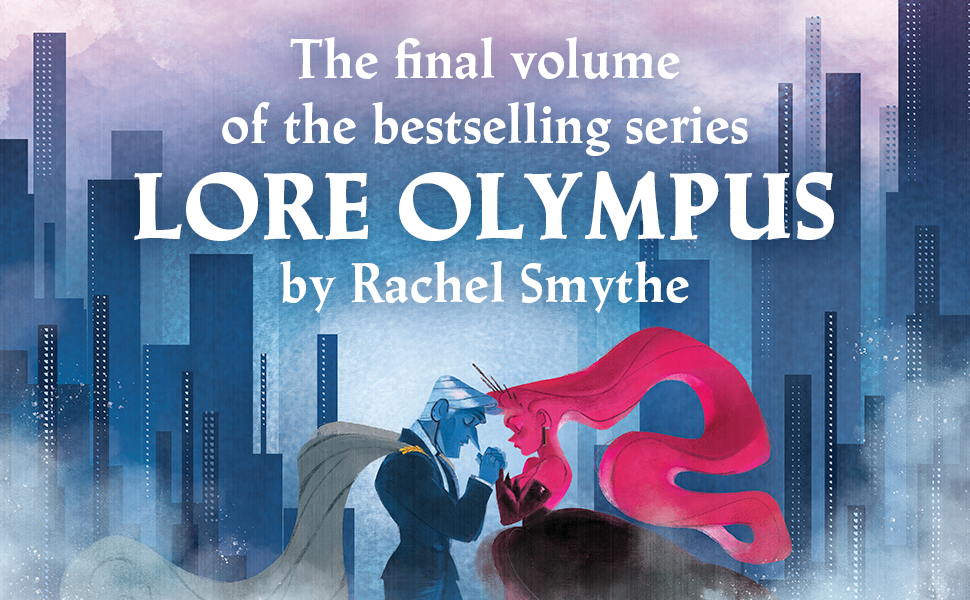
Last month, after almost a decade of storytelling, Rachel Smythe’s Lore Olympus reached its conclusion with Volume Eleven, the final instalment of a graphic novel series that has become one of the most recognisable modern interpretations of Greek mythology. What began as a contemporary retelling of the relationship between Hades and Persephone gradually developed into a much larger narrative about love, trauma, political power, family, identity, responsibility and the challenges of immortality.
The End of Lore Olympus: Volume Eleven
Volume Eleven is particularly important because it brings together the different storylines and character journeys that have developed throughout the series. The relationship between Hades and Persephone remains at the heart of the narrative, but their personal happiness has always existed alongside the complicated politics of Olympus and the conflicts between different generations of gods. The final volume provides the opportunity to bring these different elements together and give the characters a proper conclusion.
The significance of this final instalment goes beyond discovering what happens to the central romantic couple. Smythe has spent years transforming the traditional Greek myth into a story about personal independence, emotional recovery and the ability to overcome the consequences of manipulation and abuse. Consequently, the ending needs to resolve not only the larger conflicts threatening the divine world but also the personal journeys of its principal characters.
Volume Eleven is therefore both the conclusion of a fantasy adventure and the final chapter of a much more personal story. It returns to the mythology that inspired the entire project while demonstrating how much its characters have changed since their first appearances.
From WEBTOON Phenomenon to Eleven-Volume Graphic Novel
To understand the importance of Volume Eleven, it is worth remembering the extraordinary journey of Lore Olympus itself.
Rachel Smythe originally developed the series as a modern reinterpretation of the myth of Hades and Persephone. The story began appearing online in 2017 before finding its wider audience through WEBTOON. Its combination of colourful digital artwork, contemporary dialogue, romantic storytelling and Greek mythology quickly attracted an enormous international readership.
Rather than presenting the gods as distant mythological figures living in an ancient civilisation, Smythe imagined them inhabiting a recognisably modern society. Olympus became a world of corporate offices, luxury apartments, nightclubs, political institutions and complicated social relationships. Hades was no longer simply the frightening ruler of the dead, but an influential businessman struggling with loneliness and personal trauma. Persephone was not merely the innocent goddess carried away into the Underworld, but a young woman discovering her identity and learning to exercise control over her own life.
This approach helped distinguish Lore Olympus from traditional mythological adaptations. Although Smythe retained familiar characters and narrative elements, she was willing to reinterpret their motivations and relationships to explore contemporary themes.
Instead, he is presented as a complicated individual whose enormous wealth and influence conceal considerable emotional difficulties. He is powerful, intelligent and respected, but his personal history has left him struggling with loneliness, insecurity and the consequences of experiences from his childhood.
The original WEBTOON series concluded in June 2024, after three seasons and 280 episodes. However, the publication of the printed editions continued, allowing readers to experience the complete story in a collected format. Volume Eleven finally completes that process.
The final book is consequently an important publishing milestone. It is not a continuation or a new spin-off, but the final piece of a narrative that began nearly ten years earlier.
Returning to the Mythology: The Final Conflicts in Olympus
One of the strengths of Lore Olympus is the way it combines the personal stories of its characters with the larger mythology of the Olympian gods. Although the relationship between Hades and Persephone provides the emotional centre of the series, the narrative gradually expands to include the complicated history of the divine world.
Volume Eleven brings this wider mythology back into focus. The ancient tensions between different generations of gods, the struggle for authority and the consequences of past conflicts all become particularly important as the story approaches its conclusion.
For readers familiar with Greek mythology, this is an opportunity to revisit some of the most recognisable figures and themes from ancient literature. Characters such as Kronos, Zeus, Hera and Ouranos are connected to some of the foundational stories explaining the origins of the Olympian order.
In traditional Greek mythology, the history of the gods is marked by successive generations challenging the authority of their predecessors. Ouranos, the primordial embodiment of the sky, is overthrown by his son Kronos, who is subsequently defeated by Zeus and his siblings. These conflicts establish the divine hierarchy that dominates much of Greek mythology.
Smythe uses these mythological foundations to explore a broader question: whether a new generation can establish a better world without repeating the mistakes of those who came before.
This is particularly relevant to the conclusion of Lore Olympus. The series has repeatedly examined the relationship between power and responsibility, showing how authority can become destructive when it is used to control or manipulate others.
The final volume brings these themes together and gives the mythology a central role in the conclusion of the story.
Hades: Confronting the Past and Finding a Future
Hades has always been one of the most interesting characters in Lore Olympus, partly because Smythe moves away from the traditional image of him as a frightening and distant ruler of the dead.
Throughout the series, Smythe gradually explores the relationship between Hades’s past and his adult personality. His family history is particularly important, demonstrating how the actions of previous generations can influence the lives of those who come after them.
This is one of the most interesting aspects of the character’s development. Hades is not simply required to overcome external enemies; he must also learn to understand himself and recognise that his past does not have to determine his future.
Volume Eleven provides the final stage of this emotional journey. Without revealing the specific events of the concluding chapters, it is fair to say that Hades’s personal history and his relationship with his family remain important elements of the final storyline.
His development is also closely connected to the larger themes of the series. Smythe explores the possibility of breaking destructive family patterns and creating healthier relationships, even when the experiences of the past have been particularly painful.
For Hades, the conclusion is therefore about more than his position as ruler of the Underworld. It is also about the possibility of finding happiness, accepting emotional vulnerability and building a future based on his own choices.
Persephone: From Young Goddess to Independent Ruler
If Hades represents the struggle to overcome the past, Persephone represents the journey towards independence and self-discovery.
At the beginning of Lore Olympus, Persephone is introduced as a relatively inexperienced goddess who has spent much of her life in the company of her mother, Demeter. Although she possesses extraordinary abilities, she has limited experience of the wider divine world.
Her arrival in Olympus exposes her to a society that operates according to complicated political, social and personal relationships. Initially, she struggles to understand her position within this environment. She is frequently treated as someone who needs protection or guidance, and other gods make assumptions about what she should become.
However, her experiences gradually change her.
Her relationship with Hades encourages her to develop emotional independence, while her encounters with other gods force her to recognise the importance of protecting herself and establishing boundaries. Her growing understanding of her powers also makes her increasingly aware that being a goddess involves responsibilities beyond her personal happiness.
The final volume brings these different elements together.
Persephone’s journey is particularly interesting when compared with the traditional mythology. In ancient Greek religion, Persephone was not simply the wife of Hades. She was an important goddess associated with the Underworld, fertility, death and rebirth. Together with Demeter, she occupied a central position in the Eleusinian Mysteries, one of the most significant religious traditions of ancient Greece.
Smythe’s interpretation gradually gives Persephone a similarly complex identity. She is not defined exclusively by her relationship with Hades or her connection to spring. Instead, she becomes a goddess with her own authority, responsibilities and influence.
This makes the final volume particularly important for her character. It provides the opportunity to complete a transformation that has been developing since the very beginning of the series.
Hera and the Other Olympian Gods
Although Hades and Persephone are the central characters, one of the most enjoyable aspects of Lore Olympus is the attention Smythe gives to the wider cast of Olympian gods.
Hera is particularly important. In traditional mythology, she is associated with marriage, queenship and divine authority, but she is often reduced in popular culture to the jealous wife of Zeus. Smythe gives her a much more complicated personality, exploring her vulnerabilities, relationships and experiences.
Her character demonstrates that even individuals who occupy positions of considerable power can struggle with personal difficulties and the expectations placed upon them.
Other familiar gods also receive their own interpretations. Zeus is presented as a complicated ruler whose personal behaviour frequently creates difficulties for those around him. Apollo represents a more troubling form of ambition and entitlement, while Demeter’s relationship with Persephone explores the complicated balance between parental protection and personal independence.
These interpretations are important because they prevent Lore Olympus from becoming a story concerned exclusively with its central romance.
The final volume gives readers the opportunity to see how the wider cast fits into the conclusion. The supporting characters have their own histories, relationships and unresolved questions, and their presence helps make the fictional world feel considerably larger than the story of Hades and Persephone alone.
For readers who have followed the series from its beginning, this is also part of the pleasure of reaching the final volume: seeing the characters they have come to know brought together for the concluding chapter.
Hades and Persephone: Completing the Love Story
Despite the political conflicts and mythological elements, the relationship between Hades and Persephone remains the emotional centre of Lore Olympus.
Their romance is based on one of the most famous stories in Greek mythology, but Smythe makes several important changes to its traditional presentation.
In many ancient versions, Persephone’s relationship with Hades begins with her abduction, and her marriage is arranged without her consent. Her mother, Demeter, responds by searching for her daughter, and the resulting conflict becomes associated with the seasonal cycle.
Smythe retains the familiar mythological foundations but changes the emotional focus of the story. Her Hades and Persephone are individuals who must learn how to trust one another. Their relationship develops through shared experiences, misunderstandings, personal difficulties and the gradual recognition that they can provide each other with emotional support.
This is particularly important because neither character is presented as perfect.
Hades has his own insecurities and emotional difficulties, while Persephone must learn how to navigate her growing powers and responsibilities. Their relationship works because both characters are allowed to develop independently rather than simply existing to complete one another.
The final volume brings this romantic journey to its conclusion.
For readers who have followed their relationship across the previous ten volumes, the most important question is not simply whether they remain together, but how the experiences they have shared have changed them.
Smythe’s reinterpretation of the myth places particular emphasis on the importance of choice. Persephone must be able to determine her own future, while Hades must recognise that a healthy relationship requires trust and mutual respect.
This is perhaps the most important difference between the traditional myth and Lore Olympus. The ancient story often focuses on marriage, fertility and the seasonal cycle, whereas Smythe explores the emotional experiences of the two central characters.
The conclusion therefore completes more than a romantic storyline. It also completes Persephone’s transformation into someone who can make her own decisions and Hades’s journey towards a healthier understanding of himself and his relationships.
The Mythological Meaning of the Ending
One of the greatest strengths of Lore Olympus is its ability to use Greek mythology as the foundation for a contemporary story without simply reproducing the original myths.
Volume Eleven continues this approach by bringing together different generations of divine characters and exploring the consequences of their conflicts.
The stories of Ouranos, Kronos and Zeus are particularly important because they connect the final storyline to the mythological origins of the Olympian gods.
The Titanomachy, the overthrow of Ouranos and the eventual establishment of Zeus’s authority are among the foundational narratives of Greek mythology. These stories explain the origins of the Olympian order and establish the complicated relationships between different generations of gods.
Smythe uses these familiar figures to explore questions that remain relevant today.
Who has the right to exercise power? What happens when authority becomes abusive? Can a new generation establish a better society, or will it simply repeat the mistakes of its predecessors?
These questions are particularly relevant to the series’ broader exploration of family relationships and political authority.
Persephone represents an alternative to the destructive patterns associated with the older generations. Her journey is not simply about becoming powerful. It is about learning how to exercise power without sacrificing her identity or compromising her values.
This is an important distinction between Lore Olympus and many conventional fantasy stories. Victory is not simply measured by defeating the strongest enemy. It is also measured by whether the characters can build something better after the conflict has ended.
The final volume therefore returns to the mythology of divine succession while giving it a distinctly modern interpretation.
The Bonus Short Story and the Complete Collection
Another interesting feature of Volume Eleven is the inclusion of a previously unpublished bonus short story by Rachel Smythe.
This is particularly welcome because the conclusion of a long-running series can leave readers reluctant to say goodbye to its characters. The additional story provides something extra for readers of the printed edition and makes the final collection more than a straightforward reproduction of the online episodes.
The volume collects episodes 261–280 of the original WEBTOON series, bringing the printed collection to its conclusion. At approximately 448 pages, it is a substantial final instalment.
The publication of the final volume also represents the completion of an important publishing project. The online story had already concluded in 2024, but readers who followed the printed editions could finally own the complete narrative in October 2026.
For collectors, having all eleven volumes together represents a satisfying way to preserve the entire story. It also makes the series particularly suitable for readers who prefer experiencing a long graphic novel narrative in its physical format rather than following individual online episodes.
The Legacy of Lore Olympus
It is difficult to discuss the significance of Volume Eleven without considering the wider cultural impact of Lore Olympus.
Rachel Smythe helped introduce Greek mythology to a new generation of readers through a format that was particularly suited to digital storytelling.
The series demonstrated that ancient mythology could be reinterpreted through contemporary visual language without losing its connection to the original stories. Its colourful artwork, modern setting and character-driven narrative made the Olympian gods accessible to readers who might not otherwise have been interested in classical mythology.
It also contributed to a wider interest in feminist reinterpretations of ancient stories.
Persephone has frequently been presented in literature and popular culture as a passive figure whose identity is largely defined by her relationship with Hades. Smythe challenges this interpretation by giving her a much more complex personality and allowing her to become the central figure in her own story.
The same approach applies to other characters. Hera becomes more than the jealous wife of Zeus, Hades is more than the frightening ruler of the dead, and Apollo is presented through a much more critical examination of his behaviour and ambitions.
The series has also received considerable recognition within the comics industry, including Eisner, Harvey and Ringo Awards. Its conclusion marks the end of a particularly successful chapter in the development of digital comics.
Importantly, the end of the graphic novel series does not necessarily mean that Lore Olympus will disappear from popular culture. An animated adaptation involving Prime Video and The Jim Henson Company has also been announced, offering another opportunity for Smythe’s interpretation of Greek mythology to reach audiences.
Lore Olympus Volume Eleven: A Fitting Ending for Hades and Persephone
Volume Eleven represents the conclusion of an extraordinary journey that began with a relatively simple premise: what if the ancient Greek myth of Hades and Persephone took place in a modern world?
Over eleven graphic novels, Rachel Smythe transformed that premise into a much more ambitious narrative involving divine politics, complicated family relationships, psychological trauma, personal independence and the struggle between different generations of gods.
The final volume brings the most important elements of the series together. Rather than focusing exclusively on the conclusion of the central romance, it provides an opportunity to resolve the wider conflicts and complete the personal journeys of the characters who have accompanied readers throughout the series.
For Persephone, the conclusion represents the culmination of her journey towards independence. She has developed from an inexperienced young goddess into someone capable of exercising considerable power and making her own decisions. Her identity is no longer defined by the expectations of her mother, Hades or the wider Olympian society.
For Hades, the ending represents the possibility of moving beyond the influence of his family history and building a future that is not dominated by the experiences of his childhood.
Their relationship provides the emotional foundation for the entire series, but it is equally important that neither character loses their individuality in the process.
Perhaps the greatest achievement of Lore Olympus is that it manages to make an ancient myth feel relevant without abandoning the mythology that inspired it. Smythe takes familiar characters such as Hades, Persephone, Hera, Kronos, Zeus and Apollo and gives them new personalities, motivations and emotional complexities.
Volume Eleven brings this interpretation to its final destination.
After almost ten years of storytelling, the journey is complete. The eleven-volume collection provides readers with the full narrative, while the additional short story offers one final opportunity to return to Smythe’s colourful interpretation of the Olympian world.
For readers interested in Greek mythology, modern literature and graphic novels, Lore Olympus is an important example of how ancient stories can be transformed into contemporary works without losing their mythological foundations.
Its final volume closes the story of Hades and Persephone while leaving behind a lasting contribution to the modern popularity of Greek mythology. More importantly, it gives readers the opportunity to say goodbye to a group of characters whose stories have accompanied them for many years. For more information, visit the official website of the series.
Discover more from Hellenic Moon
Subscribe to get the latest posts sent to your email.