The Boys season 5 out now on Amazon Prime!
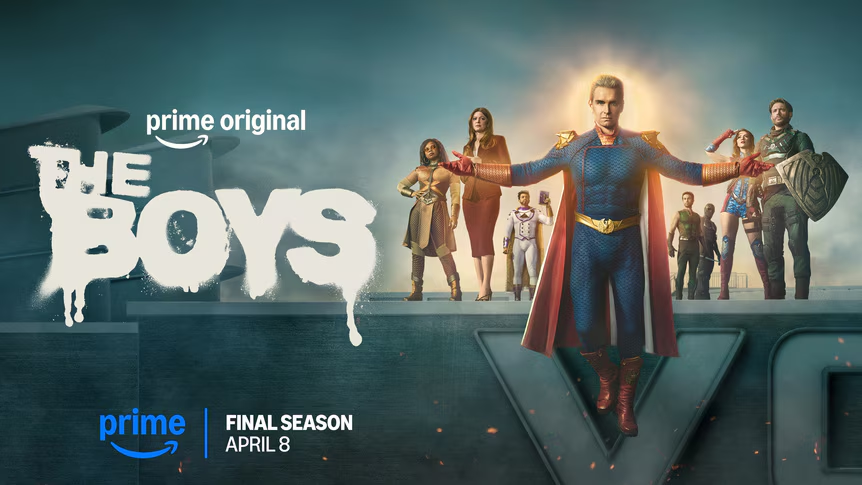
Season 5 of The Boys arrives as both a culmination and an escalation—a brutal, darkly satirical climax to one of television’s most subversive superhero narratives. Since its debut, the series—developed by Eric Kripke and based on the comic by Garth Ennis and Darick Robertson—has dissected the idea of heroism, exposing the rot beneath celebrity culture, corporate greed, and authoritarian power. In Season 5, these ideas reach their most mythic proportions, drawing increasingly clear parallels to the gods and legends of Greek mythology.
Before you read this article, we are assuming you have already read our old article about how Greek mythology influenced The Boys. In there it is explained how The Boys are influenced by The Justice League, which in turn were originally influenced by the Greek gods.
Rather than simply continuing the story, this season feels like the final act of a long tragedy—one that echoes the rise and fall of divine figures in ancient myth. Through its characters, conflicts, and themes, Season 5 transforms the modern superhero into something closer to a capricious Olympian, revealing that the distance between gods and monsters is often negligible.
The Climactic Arc of The Boys Season 5
Season 5 picks up in the aftermath of escalating chaos. The world is no longer merely uneasy about superheroes—known as “Supes”—but openly fractured by them. Governments teeter on collapse, corporations wield more influence than nations, and the line between savior and tyrant has completely dissolved.
At the center of it all stands Homelander, whose evolution into a full-blown autocrat defines the tone of the season. No longer restrained by public relations or fear of consequences, he embraces a role akin to a god-king. His followers worship him with fervor that borders on religious fanaticism, creating a chilling reflection of cults of personality throughout history.
Opposing him are the fractured members of The Boys, led by Billy Butcher, whose own moral descent mirrors the very evil he seeks to destroy. Butcher’s use of Compound V—and the toll it takes on his body and psyche—positions him as a tragic antihero, someone who sacrifices his humanity in pursuit of vengeance.
Meanwhile, Starlight emerges as a beacon of resistance, attempting to rally both humans and Supes against Homelander’s growing tyranny. Her arc in Season 5 is one of reluctant leadership, echoing mythological figures who are thrust into positions of responsibility they neither sought nor desired.
The season builds toward an inevitable confrontation—one that feels less like a superhero showdown and more like a cosmic reckoning.
Homelander as a Modern Zeus
The parallels between Homelander and Zeus become especially pronounced in Season 5. Like Zeus, Homelander occupies the highest position of power, ruling over other “gods” (Supes) and humans alike. His abilities—flight, lightning-like heat vision, invulnerability—further reinforce this comparison.
However, where Zeus is often portrayed as a flawed but stabilizing force in the cosmos, Homelander represents a darker interpretation. He embodies the worst aspects of divine authority: unchecked ego, cruelty, and an insatiable need for worship. Much like Zeus in certain myths, he demands loyalty and punishes dissent with ruthless efficiency. Yet Homelander lacks the mythological balance that Zeus sometimes provides; there is no higher order governing him.
This makes Homelander less a ruler and more a tyrant—an evolution of the Olympian archetype stripped of any redeeming qualities. His relationship with his son also mirrors mythological patterns, where divine offspring become both legacy and threat, recalling the generational conflicts seen in stories of Zeus and Cronus.
Butcher as a Tragic Hero: Echoes of Heracles and Achilles
Billy Butcher’s arc in Season 5 resonates strongly with figures like Heracles and Achilles. Like Heracles, Butcher is defined by immense strength and an almost superhuman determination to complete his “labors”—in this case, the destruction of Supes. Yet his journey is marked by suffering, loss, and moral compromise.
The use of Compound V acts as a kind of cursed gift, similar to the divine boons granted to Greek heroes. While it gives Butcher the power to stand against Homelander, it also corrodes him from within, both physically and emotionally. This duality mirrors the tragic nature of Achilles, whose invincibility is undercut by his fatal vulnerability.
In Season 5, Butcher’s choices become increasingly extreme, raising the question of whether he is still a hero at all. Like many figures in Greek tragedy, he is driven by a singular obsession that ultimately leads to his downfall—or at least to irreversible consequences.
Starlight and the Archetype of the Reluctant Goddess
Starlight embodies a very different mythological archetype. Her journey aligns with figures such as Athena, who represent wisdom, justice, and strategic thinking.
In Season 5, Starlight becomes the moral center of the narrative. While others succumb to anger or despair, she strives to maintain a sense of justice and compassion. However, this role comes with immense pressure. Like Athena, she must navigate complex conflicts, balancing idealism with pragmatism.
Her growing influence among both humans and Supes positions her as a counterpoint to Homelander—a symbol of what power could be if guided by empathy rather than ego. Yet the season also explores the cost of this responsibility, as Starlight grapples with doubt, fear, and the burden of leadership.
The Fall of Supes and the Titanomachy Parallel in The Boys Season 5
One of the most striking mythological parallels in Season 5 is its resemblance to the Titanomachy—the great war between generations of gods. In The Boys, this conflict is reimagined as a battle between different factions of Supes and the humans who seek to overthrow them.
The idea of overthrowing a ruling class of “gods” is central to both narratives. Just as Zeus and his siblings rebelled against the Titans, the characters in The Boys attempt to dismantle the oppressive system created by Vought and enforced by figures like Homelander.
However, the show subverts the myth by questioning whether replacing one ruler with another truly changes anything. If power inevitably corrupts, then any victory may simply set the stage for a new cycle of tyranny.
Corporate Olympus: Vought as Mount Olympus
The corporation Vought International functions as a modern equivalent of Mount Olympus. It is the seat of power where decisions affecting the entire world are made, often with little regard for human lives.
In Season 5, Vought’s influence becomes even more insidious. It is no longer just a corporation but a quasi-governmental entity, shaping politics, media, and public perception. This mirrors the role of Olympus as the center of divine authority, where the gods dictate the fate of mortals.
Yet, unlike the mythological Olympus, Vought is driven not by cosmic order but by profit and control. This distinction underscores one of the show’s central critiques: that modern institutions can wield godlike power without any of the accountability or purpose traditionally associated with divinity.
Themes of Power, Corruption, and Worship
At its core, Season 5 reinforces the central themes that have defined The Boys from the beginning.
The Corrupting Nature of Power
The show argues that power, when left unchecked, inevitably leads to corruption. This idea is embodied most clearly in Homelander but is also reflected in characters like Butcher, who begin to mirror the very evil they oppose.
The Danger of Idolization
One of the most consistent themes in the series is the danger of placing individuals on pedestals. The worship of Supes in The Boys parallels the reverence of gods in ancient mythology, highlighting how easily admiration can turn into blind devotion.
The Fragility of Morality
Season 5 emphasizes that morality is not absolute but constantly tested by circumstances. Characters are forced to make impossible choices, blurring the line between right and wrong.
A Tragic Ending in the Spirit of Greek Drama
As the season approaches its conclusion, it adopts the structure of a Greek tragedy. There is a sense of inevitability to the unfolding events, as though the characters are bound by fate to reach a catastrophic climax.
Much like the tragedies of Sophocles or Euripides, the story does not offer easy resolutions. Instead, it confronts the audience with the consequences of hubris, vengeance, and the abuse of power.
Whether through the downfall of Homelander, the sacrifice of Butcher, or the uncertain future of Starlight, Season 5 will end the story of The Boys.
The Boys: Modern Myths for a Cynical Age
Season 5 of The Boys elevates the series from a dark superhero satire to something closer to modern mythology. By drawing on the structures and archetypes of Greek myth, it reframes its characters as gods, heroes, and monsters—figures whose struggles reflect timeless questions about power, morality, and human nature.
Yet, unlike traditional myths, The Boys offers no comforting sense of order or justice. Its world is chaotic, its heroes flawed, and its gods deeply broken. In doing so, it captures the anxieties of the modern age, where institutions wield immense power and the line between hero and villain is increasingly blurred.
Ultimately, the show suggests that the stories we tell about heroes—and the way we choose to believe in them—say as much about us as they do about the figures themselves. Like the myths of ancient Greece, The Boys serves as both entertainment and cautionary tale, reminding us that the pursuit of power without accountability can lead not to greatness, but to ruin.
Discover more from Hellenic Moon
Subscribe to get the latest posts sent to your email.