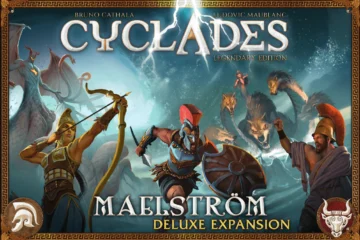
Cyclades: Legendary Edition named greatest board game of all time.. again

A few weeks ago, Cyclades: Legendary Edition was again named the greatest board game of all time by BoardGameBollocks, a YouTube channel all about board games. Every year they release an updated edition of their greatest board games of all time rankings, and once again, Cyclades: Legendary Edition is on top. You can watch the video about that here:
To celebrate this achievement again, lets take a closer look at Cyclades: Legendary Edition and how Greek mythology guides the game.
What Is Cyclades: Legendary Edition?
Cyclades: Legendary Edition is a strategic board game for 2–6 players that combines bidding, area control, civilization development, and mythological flavor set against the backdrop of an imagined ancient Greek archipelago known as the Cyclades. In the game, each player leads their own faction in a bid to dominate the mythical islands by building cities — called metropolises — and attaining supremacy through various means: military conquest, economic growth, intellectual achievement, or heroic deeds.
Legendary Edition is a Director’s Cut of the original Cyclades (2009) and its expansions, redesigned to be more dynamic with updated mechanics, modular boards, new deities, and expanded mythic features. If you get the game, we highly recommend to get the Legendary Edition and not the first edition.
Core Gameplay Mechanics
At its heart, Cyclades: Legendary Edition is about auctioning for divine favor. Each round, players bid gold (tetradrachms) to gain the support of a specific Greek god or goddess. The god you secure determines the actions available to you that turn — whether it’s moving armies, building structures, recruiting philosophers, or calling upon mythological beings.
Turn Structure and Auctions
Every round — called a cycle — begins with players gathering income based on their current holdings and prosperity markers. Then comes an auction for deities where players secretly bid gold for the favor of a god. Only one player can secure each god, and bidding strategically is crucial because the gods’ powers frame the available actions for that turn. Players must balance spending on bids with retaining gold for actions.
- If a player outbids another, the outbid player must immediately choose another god to bid on.
- Apollo, unlike the other gods, can be chosen for free — but even he offers useful benefits, such as extra income and prosperity.
The World and the Theme: Mythological Greece
The game is set in the Cyclades archipelago — a real cluster of Greek islands in the Aegean Sea that held cultural and religious significance in antiquity. Rather than basing the game on historical precision, Cyclades: Legendary Edition embraces an elevated mythological theme: it’s about how mortal city-states compete under the watchful gaze of the gods and interact with legendary beings from Greek myth.
The Gods and Their Powers in Cyclades: Legendary Edition
Perhaps the most visible link to Greek mythology in Cyclades: Legendary Edition is the role played by Olympian gods. Each deity included in the game reflects a facet of their mythological portfolio:
- Zeus: The king of the gods; in the game, gaining Zeus’ favor lets you build temples and recruit priestesses — echoing his traditional role as the divine ruler.
- Poseidon: God of the sea, sailors, and earthquakes; his favor translates into naval movement and building ports, anchoring his maritime dominion.
- Ares: God of war; in Cyclades, Ares enables the recruitment of armies and construction of fortresses, symbolizing military strength.
- Athena: The goddess of wisdom and strategic warfare; she brings intellectual development in the form of philosophers and universities.
- Hera: The queen of the gods and goddess of marriage and familial order; her abilities in the game include hiring mercenaries and heroes — powerful figures who tip the balance in battles or quests.
- Apollo: God of the sun, music, and prophecy; Apollo’s role in the game is more economic and strategic, letting players increase income and place prosperity markers, reflecting his benevolent and life-affirming aspects.
Each god’s mechanics evoke aspects of their mythological domains — military power for Ares, wisdom for Athena, civil prosperity for Apollo — and rewards players for aligning with these thematic roles.
Mythic Creatures and Heroes
Beyond the gods, Cyclades: Legendary Edition incorporates mythological creatures and heroes, playable through the bidding and god support systems.
The idea of mythological creatures — such as the Kraken, Medusa, Minotaur, Chimera, and others — comes straight from Greek lore. In the original game and maintained in the Legendary Edition, these creatures are often depicted on cards and can be summoned for powerful, one-turn effects or persistent battlefield presences.
These beings are drawn from a vast compendium of Greek myths, each with its own stories, symbolic power, and narrative weight in classical sources. For example:
- The Kraken — massive sea monster — evokes legends of destructive beasts roaming the seas (influenced by later Greek and Norse lore).
- Medusa, one of the Gorgons, turns those who stare upon her to stone, a powerful defensive motif.
- The Minotaur, half-man, half-bull, traps heroes in the Labyrinth — symbolizing brute strength and challenge.
- Chiron, the wise centaur, blends martial skill with wisdom and teaching.
Players may pay gold to recruit or use these creatures, obtaining strategic advantages — a clever way to integrate mythic flavor into gameplay mechanics.
Buildings and Philosophers: Echoes of Greek Culture
The buildings players construct — ports, fortresses, temples, and universities — also reflect classical Greek society and priorities:
- Temples pay homage to the gods — central in Greek cities and often the focus of civic life.
- Universities and philosophers nod to the Greek legacy of intellectual inquiry, philosophy, and civic debate.
- Ports underline the maritime nature of Greek civilization and its reliance on sea trade.
- Fortresses embody the frequent city-state conflicts of the ancient world.
While these components are abstract and functional in gameplay, they draw their names and thematic weight from classical cultural institutions.
Objectives and Victory: Mythic Paths to Glory
The ultimate goal in Cyclades: Legendary Edition is to be the first player to control three metropolises — grand city centers that symbolize dominance. There are multiple paths to achieve this:
- Economic Development: Build four different types of buildings, demonstrating broad civic strength.
- Intellectual Achievement: Accumulate four philosophers, reflecting the value placed on wisdom and discourse.
- Heroic Deeds: Sacrifice a hero — an evocative metaphor for the tragic and heroic acts central to Greek myth.
- Military Conquest: Seize a city by strength of arms, reminiscent of the frequent conflicts among Greek poleis.
These varied victory conditions reflect the polytheistic and multi-faceted nature of Greek cultural ideals, where intellect, heroism, piety, and military prowess all held significant value.
The Modular Map: A Mythic Archipelago
One of the notable mechanical changes in the Legendary Edition is the modular map. Instead of a fixed board, players assemble landscape tiles at the beginning of the game, creating a variable archipelago. Not only does this add replayability, but it mirrors the fragmented geography of the ancient Greek world, where city-states were separated by sea and terrain that shaped politics, trade, and war.
How Mythology Shapes Strategy
In Cyclades: Legendary Edition, Greek myth is never just wallpaper — it’s integral to decision-making:
- Choosing which god to bid on is a strategic reflection of your planned direction: military, economic, intellectual, or mercenary action.
- Summoning mythological creatures can drastically alter the game board — just as heroes and monsters shaped fate in Greek epic poetry.
- The risk-reward of auctions, city building, and battlefield engagement mirrors the capricious nature of the gods, whose favor and wrath could elevate or destroy mortal aspirations.
The game captures both the narrative spirit of myth and the competitive dynamics that such stories evoke: fortune, hubris, divine caprice, and heroic achievement.
Cyclades: Legendary Edition
Cyclades: Legendary Edition is more than a thematic veneer slapped onto a board game. It’s a carefully crafted blend of strategy and mythology. Through its auction mechanics, god powers, creature cards, and varied victory conditions, it creates an immersive world where players behave almost like city-state leaders in a mythic Greece, balancing devotion to gods with pragmatic concerns of war, culture, and economy.
Whether you’re striving to build temples under Zeus’ favor, sailing across the archipelago with Poseidon’s blessings, or unleashing mythic beasts upon rivals, the game’s mythological framing deeply informs both theme and mechanics. It’s a tribute to Greek myth — not as a static background, but as a living, shaping force at the center of your epic struggle for supremacy. For more information, visit the official page of Open Sesame Games.
Discover more from Hellenic Moon
Subscribe to get the latest posts sent to your email.